ZERO EURO
Investment Guide
“The world of investing is one of the few human activities where YOU, by studying on your own for a couple of weeks, can do better than 99% of Professionals– cit. Mr. Rip
The Physics of Wealth
Chapter 1: The Physics of Wealth
Welcome. If you're here, you probably understand that how you manage money today will determine the quality of your life tomorrow. But perhaps there’s still a voice inside you whispering: "Investing is risky," or "Investing is for the wealthy," or worse yet, "Investing is like playing in a casino." I want you to take these beliefs and set them aside for a moment. We are about to enter a world that is not governed by luck, financial astrology, or the opinions of gurus on television. We are entering the world of Financial Physics.
There are immutable laws that govern the accumulation of wealth with the same ironclad precision with which gravity governs the movement of planets. If you drop an apple, propelled by gravity, it will fall downward. You don’t have to "hope" it happens. You know it will.
Similarly, if you spend less than you earn and invest the difference in productive assets (things that create value) for a sufficiently long time, you will build wealth. It is a mathematical principle, not a lottery ticket.
The problem is that most people try to violate these laws, searching for impossible shortcuts or stellar returns without risks. In this first Pillar, we will not talk about which stocks to buy. We will understand how to align your daily actions with these universal principles. True wealth is not just the final balance in your account: it is the ability to transform your work (potential energy) into freedom (kinetic energy). Let’s begin.
Chapter 2: The Farmer Metaphor
Imagine you are a Neolithic farmer.
Your job is simple but brutal: you must prepare the soil, plant the seeds, and wait.
Can you shout at the sky to make it rain? No.
Can you threaten the sun to shine more? No.
Can you pull the seedlings up to make them grow faster? If you do, you kill them.
The intelligent investor is exactly like that farmer.
There are variables that are under your control and variables that are NOT.
The fatal mistake made by 90% of losing investors is obsessively focusing on what they do NOT control: "What will the stock market do tomorrow?", "What will the Central Bank decide?", "Will there be a recession?".
No one knows. And worrying about it is an utterly wasteful use of mental energy.
The Investor-Farmer focuses only on what they control:
- Seeding (Savings): How much do you seed every month? If you don't seed anything, you won't reap anything, no matter how good the market is.
- The Soil (Asset Allocation): Where are you planting? On rock (money under the mattress), on sand (scams and Ponzi schemes) or on fertile ground (global stock market)?
- The Time (Time Horizon): Do you have the patience to wait for the harvest? Or do you run away at the first storm?
Wealth is a deferred harvest.
It is the reward the market pays to those who have the discipline to forgo a small pleasure today (spending all their salary) for immense freedom tomorrow.
Those who want to eat today the seeds that should become trees are doomed to future hunger.
In this journey, you won't need a genius IQ. You will need the stomach of a farmer and the patience of a monk.
Chapter 3: The Time Value of Money (TVM)
Let’s delve into the technical core of finance. The foundational concept of all modern economics is the Time Value of Money (TVM).
The textbook definition is: "A euro today is worth more than a euro tomorrow."
Why?
Many respond: "Because of inflation!" True, but that's not the only reason.
A euro today is worth more because it has Optionality. It has untapped potential.
Imagine holding an acorn in your hand.
Let’s say that acorn is worth 1 cent.
But if you plant it, in 20 years you will have an oak tree. And that oak tree will produce thousands of other acorns. And those acorns will grow into a forest.
So, how much is that acorn worth today? Is it worth just 1 cent, or is it worth the potential forest it holds?
In finance, money is that acorn.
Every time you spend €1,000 on a new iPhone that you don’t really need, we’re not saying you shouldn’t do it. But you need to be aware of what you are actually spending.
You are not spending €1,000. You are killing the future forest that those €1,000 could have generated if they had been invested at 7% per year for 30 years.
(Spoiler: €1,000 at 7% for 30 years becomes €7,600. That iPhone cost you nearly eight thousand future euros).
Understanding TVM means realizing that every euro spent today has an opportunity cost.
When you look at a €50 bill, you don’t just see a piece of paper to buy something. You see capital that, if invested today, can generate returns for the rest of your life.
Your task is to invest as much as possible instead of spending it all.
💰 Calcolatore TVM – Valore Temporale del Denaro
FV = PV × (1 + r)ⁿ – Quanto crescerà il tuo capitale?
Chapter 4: The Cost of Waiting (Workshop)
"I'll start investing next year when I get a raise." "I'll start when I've finished paying for the car." "Now is not the time; the markets are too high."
These are the most expensive lies we tell ourselves. In finance, time is not money. Time is Exponent. In the formula for compound interest, time is found in the exponent, not at the base. This means that a small delay at the beginning has devastating effects on the final outcome.
If you start investing €200 a month at 20 years old, by the age of 65 you will be a millionaire (with historical average returns of 7% per year). If you wait until you are 30 to start (just a 10-year delay), to reach the same final result you will need to invest almost double every month, for your entire life. Those 10 lost years cannot be recovered by putting in "a little more." They can only be recovered through an immense effort.
The simulator you find below is designed to help you "feel" this pain physically. Try entering your current capital. Then see what happens if you wait 5 or 10 years before investing it. The difference between the two final amounts is the cost of your procrastination. It is a tax you pay to yourself for your indecision. Face it. And then decide if it's worth starting today, even with a little. Because "a little" today is better than "a lot" tomorrow.
📉 Il Costo del Ritardo
Simula quanto perdi aspettando a iniziare.
Chapter 5: The Eighth Wonder of the World
It is said that Albert Einstein, when asked what the most powerful force in the universe was, replied: "Compound Interest. Those who understand it, earn it; those who don’t, pay it."
Whether this is a true or apocryphal quote, the concept is sacred.
Compound Interest is the reason why Warren Buffett is rich. Not because he is the best investor ever (he has achieved excellent returns, but others have done better in individual years). He is rich because he has been investing since he was 11 years old. He has harnessed compound interest for three-quarters of a century.
How does it work?
Imagine investing €100. In the first year, you earn 10%. You have €110.
In the second year, you earn another 10%. But you don’t earn €10 (which is 10% of 100). You earn €11 (which is 10% of 110).
That single extra euro is the interest on the interest.
It seems insignificant.
But project this mechanism over 30 or 40 years.
By the thirtieth year, the returns generated by your past interest will far exceed the money you put in yourself.
There comes a point, called the "Crossing Point," where your portfolio earns in one year more than you earn working.
At that moment, you are financially free. Your money works harder than you do.
The problem is that the human brain is not wired to comprehend exponential growth.
We are linear. 1, 2, 3, 4, 5.
Exponential is 1, 2, 4, 8, 16, 32, 64, 128...
The curve initially looks flat. It seems like nothing is happening. This is the so-called "Valley of Disillusionment."
Many give up here. They say, "I’ve been investing for 3 years and I’ve only earned a few hundred euros, it’s not worth it."
They quit just a moment before the curve starts to spike vertically toward the sky ("Hockey Stick").
The physics of wealth requires faith in mathematics, especially when the results are not yet visible.
Chapter 6: The Snowball Effect
Warren Buffett accumulated 99.7% of his wealth AFTER turning 52.
Read that sentence again.
If Buffett had retired at 60, no one would know who he is. He would have been a decent millionaire investor from Omaha, unknown to the world.
His secret was not "achieving astronomical returns" (though they were excellent, around 22% average annual), but rather "never stopping."
He started at 11 years old and never interrupted the chain of compound interest for 80 years.
This is the Snowball Effect.
Imagine you are at the top of a snowy mountain. You hold a small snowball the size of a fist. That snowball is your initial capital (maybe €5,000).
You start rolling it down.
After the first 10 meters, the ball is just a little bigger. You've collected only a few flakes of ice.
After 100 meters, it starts to be noticeably larger.
After 1 km, the ball has become an unstoppable avalanche that knocks down trees.
In that final phase, every single roll of the ball collects more snow than it gathered in the first 500 meters combined.
Your first 10 years of investing (from 25 to 35, or from 30 to 40) are only meant to build the ball. It is the hardest and most boring phase. You have to push it yourself. It seems like nothing is happening.
But if you persist, you will reach the phase where gravity takes over. Returns generate returns. The portfolio grows on its own by €10,000 or €20,000 in a single month, without you adding a single euro.
The goal of the game is to survive long enough to see the avalanche.
Chapter 7: Project Your Future (Lab)
It's easy to talk about "the long term" in abstract terms. It's much harder to visualize it concretely.
We live in the present. Our reptilian brain wants immediate rewards. The prefrontal cortex, which plans for the future, struggles to assert itself.
To help your prefrontal cortex win, you need to give it a clear picture.
Don't invest "to get rich." It's too vague.
Invest to:
- Be able to tell your boss to shove it in 15 years (Fuck You Money).
- Pay for your children's college without debt.
- Retire 10 years before the legal age and travel the world.
Use the simulator below to get a concrete idea. Think of it as a financial "time machine."
Enter how much you can realistically save and a cautious average return (e.g., 5-7% real). See where you could be in 20 or 30 years.
That final number represents the freedom you're buying, month by month.
Important note: time is the most critical factor. Extending your time horizon even by a couple of years often has a greater impact than slightly increasing your monthly contribution. Time is the most powerful leverage you have.
📈 Simulatore: Proietta il Tuo Futuro
Investimento iniziale + versamenti mensili con crescita composta.
Chapter 8: The Invisible Thief
There is a silent serial killer lurking in your bank account. It makes no noise. It leaves no traces. But every night, while you sleep, it enters your bank's vault and scrapes away a small piece of your coins. This killer is called Inflation.
Inflation is the general rise in prices, which results in the decrease of your money’s purchasing power. If you leave €100,000 idle in your bank account for 20 years, with an average inflation rate of 2-3% (historical), in the end, you'll still see "€100,000" on your statement. The bank hasn’t stolen anything from you. But when you go to the supermarket, you'll find that those €100,000 only buy half of what they did 20 years ago. You've lost 50% of your real purchasing power. It's as if the State had imposed a wealth tax of 50% without any law and without any protests in the streets.
Investing is not (just) a way to get rich. Investing is first and foremost Legitimate Defense. If you don’t invest, you are consciously choosing to lose money every day. Being "liquid" is not a zero-risk choice. It’s a choice of “certain loss.”
The only way to defeat the Invisible Thief is to make your money run faster than it does. You must invest in assets (stocks, real estate, bonds) that historically yield more than inflation. It’s not optional. It’s survival.
📉 Simulatore Inflazione: Il Ladro Invisibile
Scopri quanto vale davvero il tuo denaro tra N anni.
Chapter 9: Your Greatest Asset
When you think of your "portfolio," you probably think of your bank account and investment account.
But you are forgetting the greatest asset, worth millions of euros: YOURSELF.
In finance, this is called Human Capital.
It is the net present value of all the salaries you will earn from now until retirement.
If you are 25 years old and earn €30,000 a year, and you plan to work for 40 years with increasing salaries, your Human Capital may be worth (discounted) around 1 or 1.5 million euros.
This asset has very specific characteristics:
- It is similar to a Bond: it pays you a periodic coupon (salary) that is fairly secure (hopefully).
- It depletes over time: each year you work, you convert a part of Human Capital into Financial Capital. By age 65, your Human Capital is almost zero.
This perspective changes everything.
Since you already own a massive "bond" (millions!), when you are young you can and MUST afford to have very aggressive Financial Capital (100% Equity).
Because if the stock market crashes by 50% when you are 20, you have lost 50% of "very little" (your small savings), while your main asset (your job) remains intact. In fact, the crash is an opportunity to buy at a discount with your future salaries.
As you get older, Human Capital dries up and Financial Capital grows. At that point, you can no longer afford to lose 50%, because you no longer have time to recover through work. This is why bonds are added for protection.
Manage yourself like a business. Invest in your education to increase the return on your Human Capital. It is the investment with the highest ROI (Return on Investment) period.
👤 Il Tuo Capitale Umano
Quanto vali economicamente oggi? Il valore attuale dei tuoi stipendi futuri.
Chapter 10: Investment vs Speculation
We have reached the end of the first pillar. And before moving on, we need to clarify a fundamental distinction that will make the difference between success and failure in your financial journey.
We haven't talked about charts, P/E ratios, or dividends. We have spoken, I hope, to your mind and to your gut. Because before building a skyscraper, you must dig the foundations. And the distinction between investment and speculation is the deepest foundation of all.
Investment: The Patience Game
An investment is something that produces value over time, regardless of daily price fluctuations.
When you buy a global stock index, you are buying pieces of thousands of companies that sell products every day, generate profits, and reinvest them to grow. Whether you look at the price or not, whether the market is open or closed, those companies are working for you. Value accumulates day after day, like interest on a savings account, even if you don't see it.
The investor has a simple strategy:
- Buy productive assets (stocks, bonds)
- Hold them for decades
- Ignore market noise
- Reinvest dividends and coupons
- Reap the rewards of global economic growth
The investor knows they are playing a game where time is on their side. With each passing year, compound interest works for them. They are not in a hurry because they know that the final destination is guaranteed by the physics of wealth.
Speculation: The Timing Game
Speculation, on the other hand, is betting that the price of something will increase in the short term so that it can be sold to someone else.
When you buy Bitcoin hoping it will be worth double in a month, you are speculating. When you try to "time" the market by selling today to buy back tomorrow at a lower price, you are speculating. When you buy the stock of the week because "everyone is talking about it," you are speculating.
The speculator has a problem:
- They must get the timing right for buying
- They must get the timing right for selling
- They must outperform millions of professional traders
- They pay higher taxes (capital gains on short trades)
- They pay more commissions (for each buy and sell)
- They live in anxiety, checking prices every hour
The speculator plays against time. Every passing day, costs devour them. Every timing mistake can cost years of earnings. And statistically, 90% of speculators lose money in the long term.
The Ultimate Test
How do you know if you are investing or speculating? Ask yourself:
"If the market were to close for 10 years and you couldn't buy or sell anything, would you be happy owning this asset?"
If the answer is yes, you are investing. Companies will continue to produce value even if you cannot control the price. If the answer is no, you are speculating. Without the ability to sell quickly, your "investment" has no intrinsic value.
What We Want
This course is built to teach you to invest, not to speculate.
We want to:
- Buy and forget for decades
- Sleep peacefully during crises
- Accumulate wealth slowly but steadily
- Leverage time and compound interest as allies
- Pay as little tax as possible (hold long-term)
We do not want to:
- Watch charts every day
- Look for the "right moment" to enter
- Compete with professional traders
- Live in the anxiety of the next crash
- Burn money on commissions and taxes
The uncomfortable truth is that speculation is exciting. Investment is boring. But wealth is built with boredom, not with excitement.
If you want to get rich quickly, this is not the right place. But if you want to become rich for sure, stay.
Now that you have the mental foundations, you are ready to dive down the rabbit hole. In the next Pillar, we will face the number one enemy: Risk. And we will discover that it is not what you think. Welcome to the game of finance.
🧩 Verification Quiz: Pillar 1
Test yourself! Answer the 10 questions to verify your understanding.
1. What is the mathematical 'engine' of wealth growth?
2. Which variable has the strongest exponential impact in compound interest?
3. What does 'Human Capital' mean?
4. How does Human Capital behave over a lifetime?
5. What is the final goal of the investor according to the Lifecycle Theory?
6. If you double the annual return (e.g., from 5% to 10%), the final result after 30 years...
7. Why is it important to start investing as early as possible?
8. What is the number one enemy of savings sitting in a checking account?
9. The formula for future wealth depends on:
10. What happens if you withdraw interest every year instead of reinvesting?
Risk, Volatility and Resilience
Chapter 1: The Wall of Certainties
We live in a modern society obsessed with security.
We insure our car, home, health, smartphone, train trips. We seek the "stable job." We want contracts with guarantee clauses.
We have been taught to believe that risk is a failure of the system, a mistake to be avoided at all costs.
It is natural, then, that when an ordinary person approaches investments for the first time, their first question is:
"Is there something safe that yields well?"
I have bad news and good news for you.
The bad news is that that thing does not exist. It's a unicorn.
If someone offers you a "safe" investment with guaranteed returns above 5% (scam), run away.
The good news is that risk is not the monster you think it is.
Risk, in finance, is the raw material. It is the fuel.
Without risk, there is no return. If you want warmth, you have to burn wood. You cannot expect to warm yourself without lighting a fire.
In this pillar, we will learn not to avoid risk, but to tame it and use it to our advantage.
We will learn to distinguish "good" risk (the one that pays you) from "bad" risk (the one that destroys you).
Welcome to the world of profitable uncertainty.
Chapter 2: The Price of the Ticket
Why do stocks average a 7-8% return per year in the long term, while savings accounts or short-term government bonds yield 1% or 2%?
Why is the stock market so generous?
It isn’t. The market is not a charity, and it doesn’t give you anything for being nice.
That 7% is a compensation. It’s the "price" the market has to pay you to convince you to endure sleepless nights, alarming newspaper headlines, wars, pandemics, and sudden crashes.
Stock returns require an upfront payment: the acceptance of volatility.
Most people want returns but don’t want volatility.
They seek the "perfect timing" to enter and exit without pain, but this approach rarely works.
The return is the reward for your ability to withstand psychological fluctuations. If you are not willing to accept volatility, you will only get the yield of Postal Bonds (i.e., almost zero in real terms).
Accept volatility as part of the process. It is the price to pay for returns.
Chapter 3: Volatility Risk
This is, perhaps, the most important conceptual distinction of your entire journey.
In everyday language, the words "risk" and "volatility" are synonyms.
"That investment is volatile" means "It's dangerous."
In professional finance, these two terms describe completely different phenomena, even opposite in some respects.
Volatility is the fluctuation of prices in the short term. It is how much the price zigzags from today to tomorrow.
Volatility is like air turbulence. Is it annoying? Yes. Does it spill your coffee? Maybe. Does it make you feel nauseous? Often.
But turbulence is NOT the plane crashing.
If your portfolio declines by 2% today, have you lost money?
The correct answer is: NO. You have experienced a temporary fluctuation in the theoretical liquidation value.
As long as you don't sell, that loss is virtual. It's just information on the screen.
The true long-term investor does not look at the portfolio every day. In fact, they celebrate volatility. If you are in an accumulation phase with a Systematic Investment Plan (SIP), volatility is an advantage: by investing the same amount each month, when prices drop, you automatically buy more shares. It's like Dollar Cost Averaging: the market gives you a discount without you having to time it.
Chapter 4: The Definition of Risk
If volatility is just noise, what is true Risk then? Risk is the Permanent Loss of Capital. It’s when money disappears and never comes back. Game Over.
This happens in two main cases:
-
Asset Failure You buy the stock of a single company, like Parmalat or a meme crypto, and it fails. The value goes to zero. There is no recovery.
-
Panic Selling The market crashes by 30%, you can’t handle the stress or you need money suddenly, and you sell everything. At that exact moment, you have turned a temporary volatility into a permanent loss, crystallized and irreversible.
That’s why diversification is essential: it eliminates risk 1, the failure of the single asset. And that’s why having a liquid Emergency Fund is crucial: it eliminates or reduces risk 2, the need to sell.
But be careful, there is a crucial distinction you need to know:
-
Compensated or Systematic Risk This is the "good" risk. It’s the intrinsic market risk, such as buying the entire global index. You expose yourself to the uncertainty of the global economic future, and in exchange for this assumption of risk, the market "pays" you with a positive expected return in the long term. This is the risk that you want to take.
-
Uncompensated or Idiosyncratic Risk This is the "unnecessary" risk. It’s the specific risk you take on by betting on a single stock, a single industry like Tech, or a single country like Italy. Since this risk can be easily eliminated through diversification, the market owes you nothing for having taken it.
If you only buy Tesla stocks and Tesla fails, the market will not compensate you for your "courage." You could have diversified and didn’t. You took on uncompensated risk.
Your goal is to completely eliminate uncompensated risk by diversifying as much as possible, and to manage compensated risk well by choosing how much equity to have in your portfolio.
If you have eliminated these two risks, that is, single failure and forced selling, and cleaned your portfolio of uncompensated risks... the daily fluctuations can’t harm you. They are waves crashing on a rock. You are the rock.
Chapter 5: The Airplane Analogy
Imagine you have to fly from Rome to New York. Your goal is to reach your destination to start a new life (your financial freedom). You board the airplane (the global stock market). After an hour, the Captain announces: "Ladies and gentlemen, we are entering a zone of severe turbulence." The plane begins to shake violently. Luggage falls from the overhead compartments. The lights flicker. You are scared. It's natural.
In that moment, what do you do? Unbuckle your seatbelt, run to the emergency exit, open it, and throw yourself into the void without a parachute? Of course not. That would be suicide. You know that the turbulence is unpleasant, but the airplane is designed to withstand it. You know it will pass. Yet, in finance, that’s exactly what millions of investors do during a market crash. As soon as there is "turbulence" (the market drops 20%), they panic and jump out of the exit (sell everything and go to cash), crashing to the ground (permanent loss). If they had stayed seated with their seatbelts fastened (held), they would have arrived in New York a bit shaken but safe and sound.
Historical data is unequivocal: in over 100 years of history, a well-diversified global equity portfolio has NEVER gone to zero. It has always recovered from every world war, every pandemic, and every crisis. The only way to truly lose is to jump out of the airplane mid-flight. Stay seated.
Chapter 6: Volatility Lab
Now let's get our hands dirty with the numbers. Many people say, "I want an 8% return, but I don't want to see my portfolio drop more than 5%." It's like saying, "I want to become an Olympic marathon champion, but I don't want to sweat or get tired ever." Physics doesn't allow for that.
Use the simulator below. We have launched 50 Parallel Universes. Each of those gray lines is a possible future for your portfolio, based on the same premises, namely return and volatility.
What is Volatility? In finance, volatility is measured as the standard deviation of returns. In practice, it indicates how much returns fluctuate around the average. A volatility of 15% (typical of a well-diversified 100% global equity portfolio) means that in about 68% of cases, the annual return will be within the average ± 15%. For example, if the average return is 8%, you expect returns between -7% and +23% most of the time.
Try entering an 8% return and a 15% volatility. Do you see the chaos? The thick Blue line is the "Theoretical Average." It's the one they show you in brochures. Smooth, perfect, always rising. The gray lines are reality. Some will make you rich, others will make you suffer. The Red line is the worst-case scenario occurred in our 50 simulations.
You will notice that in the long term, let's say 15 or 20 years, most lines tend to rise nonetheless, driven by the power of compound returns. But the journey is never a straight line. Volatility is the price. Growth is the reward. You can't separate the two. Learn to love that jagged graph. It's the heartbeat of your wealth that's growing. A flat graph is a dead graph, just like money under the mattress.
📊 Simulatore Volatilità
Visualizza come media e deviazione standard creano percorsi reali diversi.
Chapter 7: The Cruel Asymmetry
There is one true mathematical reason to be cautious and not take excessive risks, avoiding going "all-in": the Asymmetry of Losses.
Gains and losses in percentage terms are not equal.
Our intuitive brain thinks: "If I lose 50%, then I just need to gain +50% to break even."
FATAL ERROR.
Let's do the math:
You have €100. You lose 50%. You are left with €50.
Now, to get back to €100 starting from €50, you need to gain another €50.
But €50 on a base of €50 represents a gain of 100%!
You have to double your capital just to return to square one. And doubling capital is difficult; it takes time and risks.
If you lose 90%, as happened to many tech stocks during the dot-com bubble, to break even you need to achieve +900%. You need to do an "x10." It’s almost impossible.
This law explains why Warren Buffett's first rule is "Don't lose money" (I mean permanent/deep losses).
A drawdown, or peak-to-trough decline, of 10% or 20% is normal and can be easily recovered with a +12% or +25% return.
A drawdown of 50% or 60% is a chasm that may take a decade to fill.
That’s why portfolios are built with a portion of "buffers," such as bonds, gold, or cash: to avoid a decline that becomes so deep that recovery in a human timeframe becomes mathematically impossible.
To engrave the concept of asymmetry in your mind, use the calculator below.
Enter a percentage loss, the so-called Drawdown, and observe the "Required Recovery" column.
Notice that up to 15-20%, the two figures are similar. The damage is manageable.
But exceed the threshold of 30-40% and you will see the curve spike vertically.
At -50%, the recovery requirement doubles.
At -75%, the requirement quadruples.
This graph and the numbers you see should terrify you. They are designed that way.
They should teach you that the real enemy is not "not earning enough," but "digging a hole too deep."
A portfolio that shows +50% one year and -50% the next appears to have an average return of 0%, right? WRONG. Look at the concrete numbers: start from €100, rise to €150 (+50%), then drop to €75 (-50% of €150). Final result: you’ve lost 25% even though "the average" was zero. This is why real compounded return matters, not simple arithmetic average.
Stability, or reducing drawdowns, is the secret to maximizing the final compounded return or CAGR (Compound Annual Growth Rate).
"Slow and steady wins the race." In finance, this is literally true: those who avoid major crashes outperform those who make big gains followed by big disasters.
⚡ Calcolatore del Baratro – Asimmetria delle Perdite
Scopri quanto devi guadagnare per recuperare da una perdita.
| Perdita | Recupero Necessario |
|---|---|
| -10% | +11.1% |
| -20% | +25.0% |
| -30% | +42.9% |
| -40% | +66.7% |
| -50% | +100.0% |
| -60% | +150.0% |
| -70% | +233.3% |
| -80% | +400.0% |
| -90% | +900.0% |
Chapter 8: The Only Free Lunch
In the world of economics, there is an unwritten law: "There are no free lunches." If you want higher returns, you must take on more risk. It’s the currency of exchange. However, there is a single mathematical exception to this rule. Nobel laureate Harry Markowitz called it "the only free lunch in finance."
It’s called Diversification.
The Magic of Correlation
Imagine selling swimsuits. If it rains, you earn nothing. High risk. Now imagine having a friend who sells umbrellas. If it’s sunny, he earns nothing. When you partner up, magic happens: you always earn. When it rains, you sell umbrellas. When it’s sunny, you sell swimsuits. The average return remains the same, but volatility (the risk of making zero revenue) drastically collapses.
Don’t Put All Your Eggs in One Basket
This old adage is supported by more sophisticated mathematics. Adding uncorrelated assets (that don’t move together) to your portfolio reduces overall risk WITHOUT necessarily reducing expected returns.
Investing in a single asset class? Risky. Investing in a mix of different assets that behave differently? You’re building an unsinkable ship. Because when one engine falters, the other often speeds up. Diversification is the insurance you get paid by the market, instead of paying for it yourself. It’s the only way to sleep soundly while your money works.
Chapter 9: Know Thyself
There is no "Perfect Portfolio" in absolute terms. There is only the perfect portfolio for you.
To find it, you need to solve an equation with two personal variables:
-
Risk Capacity: This is an objective, financial fact.
How much money can you afford to lose without your life changing?
If you’re a 25-year-old living with your parents, have a stable job, and are investing money you won’t need for 30 years, your risk capacity is VERY HIGH. Even if you lose 50%, you won’t end up on the street. You have time to recover.
If you’re a 60-year-old nearing retirement with little savings, your capacity is LOW. A downturn might force you to forego medical care or sell your home. -
Risk Tolerance: This is a subjective, psychological fact.
How do you react when you see red?
Do you sleep at night? Do you get gastritis? Do you argue with your spouse? Do you check the banking app every 5 minutes in a panic?
There are wealthy 20-year-olds (high capacity) who panic over a -5% (low tolerance).
There are zen 60-year-olds (low capacity) who wouldn’t bat an eye at a -30% (high tolerance).
The classic mistake is to look only at the numbers (Capacity) and ignore the emotions (Tolerance).
Many advisors tell you: "You're young, put everything in stocks!"
Mathematically correct. But if you then sell everything at the first downturn out of fear, that advice has ruined you.
The best portfolio is the one you can hold onto (Hold) even in the worst days.
In the lab below, you'll find an interactive questionnaire that will help you understand your personal risk profile, combining both your objective capacity and your psychological tolerance. There are no right or wrong answers: only honest answers.
Chapter 10: The Golden Rule
Here is the final formula for determining your risk profile.
The risk you should assume must be the LOWER of your Capacity and your Tolerance.
Risk Assumable = Min(Capacity, Tolerance)
Example 1: Young (High Capacity) but anxious (Low Tolerance).
You should invest prudently (e.g., 40% stocks, 60% bonds). Of course, you will forgo some potential returns (opportunity cost), but you will avoid the catastrophic risk of selling everything in panic (panic selling). A mediocre return is better than a capital loss.
Example 2: Elderly (Low Capacity) but reckless (High Tolerance).
You must invest wisely! Even if you feel like Rambo and are not afraid of anything, if you lose your pension money, you are ruined. Math triumphs over courage.
Only when both Capacity and Tolerance are HIGH can you afford aggressive portfolios (100% stocks).
Your task from now on is to work on both variables:
- Increase your Capacity by saving and creating an Emergency Fund.
- Increase your Tolerance by studying (knowledge dispels fear) and getting used to volatility.
Only then can you afford more "engine" and less "brake" portfolios, and accelerate toward wealth.
But don’t cheat. If you respect your limits, you will arrive safe and sound. If you ignore them, a crash is guaranteed.
🧩 Verification Quiz: Pillar 2
Test yourself! Answer the 10 questions to verify your understanding.
1. What does Volatility measure in finance?
2. What is 'Drawdown' risk?
3. If you lose 50%, how much do you need to gain to break even?
4. What is 'Risk Capacity'?
5. What is 'Risk Tolerance'?
6. Is saving money under the mattress risk-free?
7. Which asset class has historically the highest risk/volatility?
8. Volatility in the long term is:
9. What does 'Risk Adjusted Return' mean?
10. Can 'Idiosyncratic' risk (of a single company) be eliminated?
Financial Markets
Chapter 1: The Great Theater of Finance
"The stock market is the only store in the world where customers run away when there are sales."
Imagine entering an immense global market, a bazaar that never closes, where billions of euros change hands every day in the blink of an eye. This is not a casino, although many treat it as such. It is the pulsating engine of the global economy, the mechanism through which humanity finances its progress. Welcome to the Financial Markets.
The financial world offers a vast and complex arsenal of instruments. In this pillar, we will explore all types of assets available in the market, from the simplest stocks to the most complex derivatives, from safe bonds to speculative cryptocurrencies. But to navigate this apparent chaos, you must understand a single, fundamental truth.
When a company or a state needs money to grow, it has only two fundamental paths available.
The first is to take out a loan, meaning to create Debt. The company says: "Lend me some money, and I will pay you back with interest." This is the realm of Bonds, where the keyword is safety and stability.
The second is to give away a piece of itself, meaning to offer Equity. The company says: "Give me money, and you will become my partner. If I do well, you earn with me. If I fail, you lose with me." This is the vibrant world of Stocks, where the risk is higher but the rewards can be unlimited.
Everything else, such as derivatives, options, futures, crypto, and commodities, is built on this foundation or represents more complex and risky variations of these two primordial concepts.
In this pillar, we will not just list definitions. We will analyze in detail how Stocks work, distinguishing between different types and understanding what truly drives their prices. We will then move on to the world of Bonds, discovering how government and corporate securities can protect your capital.
We will also venture into the more complex territories of Derivatives, such as options and futures, and into the new digital world of Cryptocurrencies, before touching on alternative assets like Commodities and REITs.
Finally, we will tie everything together by understanding Market Mechanics, discovering how correlation and diversification are the true secret weapons of the smart investor.
Note: ETFs, which are the ideal container for these instruments, will be the stars of the next pillar. Here we focus on the "bricks" that compose them.
By the end of this pillar, the market will no longer be a mysterious enemy to conquer or a beast to tame. You will see it for what it truly is: a tool. A powerful, complex, sometimes frightening tool, but absolutely essential for anyone looking to build lasting wealth.
History teaches us that there is no return without risk. But it also teaches us that risk, when understood and managed, is the price of the ticket to financial freedom.
Are you ready to become a true capitalist? Let's begin.
Chapter 2: Stocks - Become the Master
Buying a stock does not mean betting on a red or green number flashing on a screen. It means buying a piece of a real business. It means becoming an owner.
When you buy a share of Apple, you are not buying a "tech stock." You are buying the patents of the iPhone, the glass stores in Manhattan, the minds of engineers in Cupertino, and a portion of the future earnings that will be generated from every app sold. You are a partner of Tim Cook, even if you own just one-millionth of the company.
What It Means to Own Stocks
Stock ownership gives you the right to the profits of the company, often distributed in the form of dividends. It’s money working for you while you sleep, a share of the profits generated by the business.
But why do stocks go up? In the short term, prices are slaves to emotion: news, fears, greed, and impulsive tweets can swing quotes relentlessly. But in the long term, the price of a stock follows a single guiding star: Profits.
If a company sells more products, becomes more efficient, and earns more year after year, its value must rise. It’s an economic law of gravitation. The global stock market is, ultimately, a bet on human ingenuity and our ability to solve problems and create value. This is why investing in stocks is the only way to truly participate in the creation of global wealth, historically outpacing inflation.
The Stock Arsenal
Not all stocks are created equal. The market offers different types of securities, each with its own characteristics.
Companies are classified primarily by Size or Market Capitalization. This ranges from gigantic Large-Cap (like Apple and Microsoft), mature and stable, to Small-Cap, smaller, agile companies with explosive growth potential but a much higher likelihood of failure. There are also Micro-Cap stocks, extremely volatile and risky, often a playground for speculation.
Another major division is between Growth and Value. Growth stocks belong to rapidly expanding companies (often in tech: think Tesla or Nvidia) that reinvest all their profits to grow even more, often resulting in volatility and high prices relative to current earnings. Value stocks, on the other hand, are solid, often undervalued companies that pay regular dividends and offer greater stability.
Finally, let's not forget geography. You can invest in Domestic companies (Italy/Europe), in Developed Countries (USA, Japan, etc.), or venture into Emerging Markets (China, India, Brazil), accepting greater volatility in exchange for access to rapidly growing economies.
Chapter 3: The Engine of Growth
We've said that volatility is the price to pay. But for what? Why should you endure these roller coasters? Because, in the long run, the stock market rises?
It’s not magic and it’s not luck. There’s a powerful engine that pushes prices upward, made up of three fundamental cylinders.
Human Ingenuity and Innovation
When you invest in a global index, you’re not buying "paper." You're funding millions of people who wake up every morning with a goal: to do things better than yesterday. Finding a cure for a disease, inventing a faster smartphone, transporting goods more efficiently, building safer homes. This relentless drive for improvement creates value. And that value translates into economic growth. You are betting on humanity's ability to solve problems.
Reinvested Earnings
Companies don’t just cash in profits and stash them away. A portion of those profits is paid out to you (dividends), but a huge part is reinvested. The company uses its earnings to buy new machinery, hire better talent, open new branches, or conduct research. This compounded reinvestment ensures that the company itself becomes larger and more productive year after year. It’s like a tree that uses its fallen leaves to nourish its roots and grow even taller.
Protection from Inflation
Stocks are "pieces of real businesses." If there’s inflation and the price of bread doubles, the baker will collect double. Companies have the power to raise the prices of their products to keep up with inflation. Unlike bonds or cash, which are eaten away by inflation, stocks tend to float above it, preserving your real purchasing power.
Don't invest to "make easy money." Invest to participate in the creation of humanity's wealth. Volatility is just the background noise of this engine running. Sometimes it coughs, sometimes it accelerates, but the long-term direction is given by our evolution. As long as you believe that tomorrow people will want to live better than today, you have a reason to be invested.
Chapter 4: Bonds - Debt is Security
While stocks make you an owner, Bonds make you a banker. A bond is, in its purest essence, a loan. When the State or a company needs liquidity, rather than knocking on a bank's door, it turns to the market by issuing a security that promises two things: the return of the lent capital by a certain date (maturity) and the payment of periodic interest (coupon) as a thank you for the trust.
Why Buy Debt?
The answer is simple: certainty. In a financial world dominated by uncertainty, knowing exactly how much you will earn and when is a luxury that has invaluable worth. Bonds serve two vital functions in your portfolio.
The first is to generate income: the coupons are regular cash flows that you can use to live or reinvest. The second, and perhaps more important, is to act as a buffer. Often, when stocks crash due to fears of a recession, bonds tend to remain stable or even rise, acting like the airbag in your car: they won’t make you go faster, but they will save your life in case of an accident.
A World of Debts
Not all debts are equal. The bond market is vast and diverse, primarily categorizable by issuer and structure.
Government Bonds (such as Italian BTPs or US Treasuries) are issued by governments. They are generally considered the safest investment possible because a government has the power to tax its citizens or print money to honor its debts. For this reason, they typically offer lower yields. In Italy, the yields from qualified government bonds benefit from a reduced tax rate of 12.5% instead of the 26% applied to stocks and equity ETFs.
Corporate Bonds, on the other hand, are issued by companies. Here the risk is higher — a company can default much more easily than a government — and consequently, the yields offered are higher. Rating agencies help us navigate this sea, assessing both states and companies and distinguishing between solid "Investment Grade" issuers (like Apple, Microsoft, or stable states like the USA and Germany) and riskier "High-Yield" or "Junk" issuers, which promise stellar returns in exchange for a real default risk.
Along with the issuer, the structure also varies. Most bonds pay a fixed coupon, simple and predictable. Others, known as Zero-Coupon bonds, pay nothing during the life of the loan but are sold at a significant discount to the redemption value. There are also variable-rate bonds, which protect you if rates rise, and inflation-indexed bonds (such as Italian BTP Italia for Italian inflation, BTP€i for European inflation, or US TIPS), specifically designed to defend your purchasing power from monetary erosion.
The Time Factor
Finally, there is the duration. Short-term bonds (under 3 years) are almost akin to cash: low volatility and very safe. Long-term bonds (over 10 years) offer higher yields to compensate for the prolonged commitment, but as we will see in the next chapter, they carry a sneaky risk related to interest rates. The golden rule is that the longer the maturity, the higher the yield, but also the greater the price volatility.
Chapter 5: The Dark Side (Interest Rate Risk and Duration)
Many investors fall into the trap of believing that bonds cannot lose value. It’s a mistake that can be costly. It’s true that if you hold a bond until maturity and the issuer doesn’t default, you’ll get your capital back. But what happens if you need to sell before then?
This is where the public enemy number one of bonds comes into play: Interest Rates.
The Iron Law
There exists a mechanical inverse relationship, almost a physical law of finance: if rates rise, the price of bonds falls.
To understand why, imagine you own an old bond that pays 1%. Suddenly, market rates rise, and new bonds identical to yours are issued but pay 1.5%. Who would ever want to buy your old bond at 1%? No one, unless you "sell it off" at a lower price, thus compensating for the lower yield with a gain on the purchase price. That fire sale is, technically, the capital loss you see in your portfolio.
Duration: The Risk Multiplier
The sensitivity of a bond to this phenomenon is measured by Duration. Although it is expressed in years, you should think of it as a risk multiplier.
Rule: A bond with a duration of 10 years will lose about 10% of its value for every 1% increase in rates.
That’s exactly what happened in 2022 when "safe" long-term bonds lost 30-40% of their value because rates went from zero to over 4% in no time. The year 2022 was a unique event: the fastest and most violent rate hike of the last decades, imposed by central banks to curb post-COVID inflation. The lesson is brutal but clear: extending the maturity to seek a few extra basis points of yield transforms your "airbag" into another source of danger.
The Other Monsters
Beyond rates, the bond investor must be wary of other risks.
The most obvious is Default Risk, which is the possibility that the issuer will not repay the debt. This is rare for government bonds from developed countries but real for corporate bonds or those from emerging markets. There’s also Inflation Risk: if inflation is running at 5% and your bond yields 2%, in real terms you are becoming poorer with each passing day.
Finally, don’t forget about Currency Risk. Buying a U.S. Treasury bond may seem safe, but if the dollar loses 10% against the euro, your loss on the exchange rate could erase years of coupon payments.
The truth is that bonds are not "safe" in an absolute sense. They are "safer" than stocks because they are less volatile and offer certain cash flows, but they still require understanding and respect.
Chapter 6: Bond Ladder vs ETF
Now that we understand the risks (Rates and Duration), a practical question arises: how do I buy these bonds? You have two main paths. And the choice once again depends on your objective.
1. The Sniper: The Bond Ladder
The "Bond Ladder" approach involves buying individual bonds with different maturities and holding them until maturity. For example: You buy a BTP maturing in 2026, one in 2027, one in 2028, and so on.
The magic advantage: If you hold the bond until maturity, you ignore price volatility. Rates go up? The price of your bond drops on paper? You don't care. You know that in 2027 you will receive exactly your €100 + the coupons. You are "immunizing" the interest rate risk for that specific date. It's ideal for planned expenses.
2. The Conveyor Belt: The Bond ETF
The bond ETF is a fund that buys hundreds of bonds for you. But beware: to maintain a constant duration (e.g., 7-10 years), the ETF never holds the securities to maturity. It sells the bonds that are about to mature and buys new longer ones. It's an infinite conveyor belt.
The problem: Since there is never a "final maturity," you are always exposed to interest rate risk. If rates rise (as in 2022), the ETF loses value and you do not have the guarantee of recouping your capital at a specific date. However, the ETF immediately starts buying new bonds that yield more. So your future yield increases.
Chapter 7: Derivatives - Options and Futures
Note: This chapter is designed to enhance your financial literacy. Derivatives are complex instruments, often double-edged swords, typically reserved for professionals and experienced traders.
Beyond Ownership and Debt
If stocks and bonds are the building blocks of the economy, derivatives are the bets made on those blocks. As the name suggests, they are instruments whose value "derives" from something else: a stock, an index, a commodity, or an interest rate.
Options are contracts that give you the right—but not the obligation—to buy or sell an asset at a predetermined price (Strike Price) by a certain date. To have this privilege, you pay an immediate cost called Premium.
- Call (Bullish): You bet that the price will rise. If the market price exceeds the Strike Price, you earn the difference. Your maximum risk is limited to the Premium paid, while your potential gain is theoretically unlimited (see green chart below).
- Put (Bearish/Protection): You bet that the price will fall. If the price crashes below the Strike Price, the value of your option increases, offsetting losses in your stock portfolio. It's like insurance: you pay a premium upfront to be covered in case of disaster (see red chart below).
Futures, on the other hand, are binding contracts. Here you commit to buying or selling the asset at a future date. They were created to allow farmers to lock in the price of wheat before harvest, eliminating uncertainty, but today they are heavily used by speculators exploiting leverage. Leverage is the superpower (and curse) of derivatives: it allows you to move large amounts of capital by investing small sums, magnifying gains but also losses that can exceed the invested capital.
For the passive investor building wealth over the long term, these instruments are rarely necessary. They add complexity, costs, and risks that often do not justify the benefits. However, knowing they exist and how they work is essential to understanding the full architecture of financial markets.
Chapter 8: Cryptocurrencies - The New Digital World
Note: Cryptocurrencies do not have a long history behind them, and their future behavior is still a topic of debate. Currently, they are speculative assets with extreme volatility.
Beyond Traditional Currency
Cryptocurrencies are not just digital coins; they are attempts to reinvent the very concept of money and finance using cryptography and blockchain technology. At the core of it all is the idea of decentralization: a system where no central bank or government has the power to print money or censor transactions.
The undisputed king is Bitcoin, often referred to as "digital gold." Launched in 2009, it introduced the concept of absolute digital scarcity: there will never be more than 21 million coins. It has become a speculative store of value for those fearful of fiat currency devaluation. Then there is Ethereum, which goes beyond mere currency: it is a programmable platform on which decentralized applications and smart contracts are built.
There are thousands of other cryptocurrencies ("altcoins"), but the vast majority are experimental projects, worthless memes, or, worse, scams.
Risks and Realities
For an investor, cryptocurrencies represent a double-edged sword. On one hand, they offer the possibility of astronomical returns, on the other, they come with extreme volatility: losing 50% or 80% of value in a matter of weeks is almost the norm, not the exception.
The fundamental problem is that they generate nothing: there are no earnings, no dividends, no coupons. The only way to profit is to find someone else willing to buy them at a higher price than yours. It's the classic "house of cards" of financial theory.
This makes them purely speculative assets. They can have a place in a well-diversified portfolio as a bet on the future of blockchain technology, but allocating a significant percentage of one’s wealth to cryptocurrencies is gambling, not investing. Additionally, they carry unique technological risks: losing private keys means losing your funds forever, with no customer service hotline to call.
For the passive investor looking to build wealth over the long term, cryptocurrencies are not necessary. If you choose to include them, they should occupy only a tiny part of the portfolio.
Chapter 9: Other Assets - Beyond the Ordinary
Beyond the classic stocks-bonds duo, the financial world offers a myriad of alternative assets. While they are often not essential for a solid portfolio, knowing them helps you better understand the options available to you.
Commodities: The Raw Materials
Commodities are the physical bricks of the economy: oil, gas, grain, metals. Unlike stocks, they do not produce cash flows; their value depends purely on scarcity and demand.
Gold deserves a separate discussion. For millennia, it has been considered the ultimate safe haven, a protection against inflation and systemic crises. However, it is a non-productive asset: a gold bar in a safe will remain unchanged in a hundred years, generating not a single cent in profit. It should be viewed more as insurance than as an investment.
Other commodities, such as oil or agricultural products (the famous orange juice from the movie "Trading Places"!), are extremely volatile and complex, influenced by unpredictable factors like weather, geopolitics, or wars. For the average investor, they often do not justify the risk.
Real Estate on the Stock Market: REITs
Many love real estate but hate management (tenants, maintenance, taxes). REITs (Real Estate Investment Trusts) are often presented as the solution: publicly traded companies that own properties and distribute profits.
However, it is crucial to understand a critical difference: REITs are stocks, not real estate. When you buy a physical apartment, the price does not fluctuate every second. When you buy a REIT, you are purchasing a stock that behaves like one. It has the volatility of the market, suffers from interest rate increases, and can lose 30-40% in a year, just like shares of Apple or Google. Don't think that having REITs in your portfolio equates to having "the safe brick." It is exposure to the real estate sector, but with the dynamics (and risks) of the stock market.
Advanced Speculative Instruments
Finally, there are purely speculative instruments such as Forex (currencies) and CFDs (Contracts for Difference). Here we enter the territory of professional trading, often characterized by the use of leverage: a mechanism that amplifies both gains and losses, potentially wiping out your capital in minutes.
Private Equity and Hedge Funds also fall under alternative assets, but they are generally reserved for institutional or very wealthy investors, with high costs and entry barriers that rarely justify the benefits for small savers.
The truth is that to build solid wealth, there is no need to complicate your life with exotic instruments. A well-diversified portfolio of stocks and bonds is more than sufficient to achieve any financial goal.
Chapter 10: The Art of Correlation
We have seen how stocks and bonds work. But the real secret to building a solid portfolio lies not in choosing individual assets, but in understanding how they perform together. This is called correlation.
The Mathematics of Diversification
Correlation simply measures how closely two assets tend to move together. If you own two stocks that rise and fall in unison (high correlation), you have diversified nothing: you have merely doubled your bet. True security arises when you combine assets that "ignore" each other or, better yet, move in opposite directions.
Imagine a portfolio made up solely of technology stocks. If the sector crashes, your wealth crashes. But if you add government bonds, something interesting happens. Historically, when the stock market panics (recessions, crises), investors sell stocks and rush towards the safety of government bonds. This drives up the value of bonds just as stocks decline.
The Perfect Pair
This is the secret of the classic balanced portfolio (often referred to as 60/40): when one part suffers, the other often thrives, or at least cushions the blow.
If the stock market plummets by 50%, a 100% equity investor sees their capital halved. But someone with 40% in bonds (which may rise by 10% due to the flight to safety) will experience a much smaller loss, perhaps 25%. You have reduced the pain by half, allowing you to stay invested and not sell at the worst moment.
Of course, diversification has a cost: when stocks soar, bonds act as a drag, slightly reducing the overall gain. Stocks bring growth. Bonds bring stability. Together, they create a portfolio stronger than the sum of its parts. And there are rare and unfortunate years (like 2022) when everything declines together because inflation hits everywhere. But in the long game of decades, diversification remains the only "free lunch" in finance: it dramatically reduces risk at the cost of only a small fraction of potential returns.
Now that you understand assets and how they work together through correlation, you are ready to discover the tool that makes all this accessible with just one click: the ETF.
🧩 Verification Quiz: Pillar 3
Test yourself! Answer the 10 questions to verify your understanding.
1. What distinguishes Stocks from Bonds?
2. What is the main risk of fixed-rate Bonds?
3. In a risk/return hierarchy, which order is correct?
4. What happens in a 'Bear' market?
5. What is Correlation risk?
6. Are derivatives (Options/Futures) recommended for the average investor?
7. Bitcoin is considered:
8. Geographic diversification serves to:
9. A bond with high Duration is:
10. The correlation between Stocks and Safe Government Bonds is typically:
The ETF Revolution
Chapter 1: The Democratic Revolution
In 1993, an invention changed finance forever: SPY (SPDR S&P 500 ETF Trust) was born.
Before ETFs, if you wanted to invest in the stock market, you had two painful paths:
Stock Picking:
You had to buy individual stocks (expensive, risky, and difficult).
Active Mutual Funds:
You had to give your money to a bank, pay ridiculous entry fees (3-4%) and insane annual management costs (2-3%), only to achieve returns that were almost always below the market.
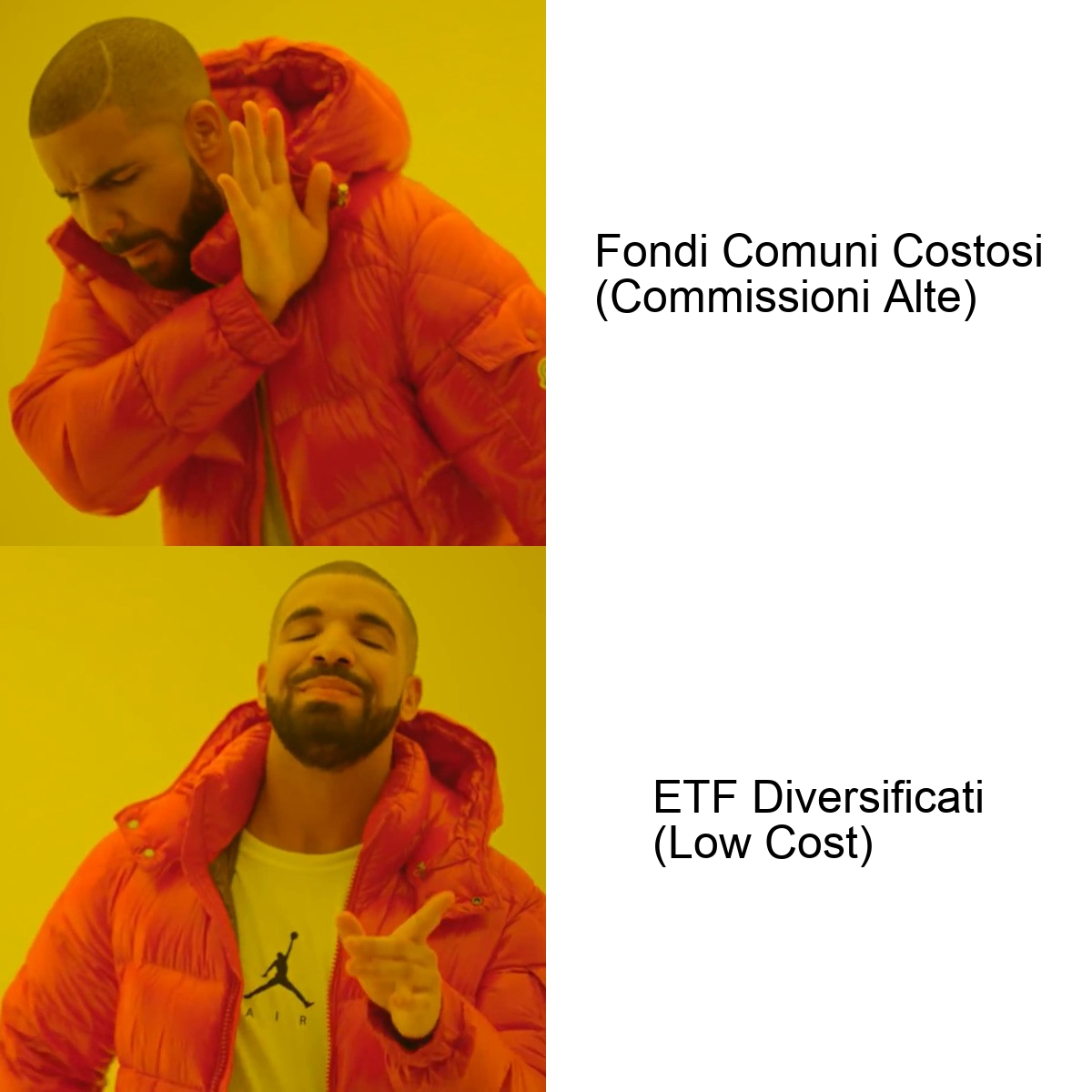
The rational choice explained in 2 seconds.
The ETF (Exchange Traded Fund) shattered this oligopoly.
An ETF is a "basket" of securities that has two revolutionary features:
It’s a Fund:
It allows you to buy 500 or 3,000 companies with a single click (instant diversification).
It’s Exchange Traded:
It buys and sells like a stock, in real-time, during market hours. You don’t have to wait for the end-of-day NAV like in mutual funds.
It’s total democratization. Today, with €50, you can buy a piece of the entire world, paying ridiculous fees (0.07% - 0.20% per year).
For banks, it was a disaster (they lost their hefty fees). For you, it was salvation.
Why Passive Management Beats Active Management
The ETF follows a passive management philosophy: it simply replicates an index (e.g., S&P 500) without trying to beat it.
Traditional mutual funds follow an active management approach: a manager tries to select the "best" stocks to outperform the market.
Burton Malkiel, in his book "A Random Walk Down Wall Street," demonstrated that over 90% of active managers underperform the index in the long run (10-20 years).
Why?
Costs Erode Returns:
If an active fund costs 2% per year and the passive ETF is 0.15%, that manager must beat the market by at least 2% just to break even. Year after year, it’s mathematically impossible for the majority.
Luck Doesn’t Last:
Some managers "beat" the market for a few years, but most do so by luck, not skill. In the long run, luck evaporates, and the costs remain.
Market Efficiency:
Stock prices already incorporate all available information. "Beating the market" means being smarter than millions of other investors. Is it possible? Rarely.
Conclusion: Passive management doesn’t aim to be the best. It seeks to be average (the market), but with extremely low costs. And this, in the long run, beats almost everyone.
Chapter 2: The ETP Family (ETF, ETC, ETN)
We often use the word "ETF" to refer to everything, but technically we are talking about ETP (Exchange Traded Products).
It is essential to understand the legal differences, as they change the risk.
The ETP family has three members:
ETF (Exchange Traded Fund)
It is a collective investment scheme.
The key feature is Asset Segregation. The fund's money is separated from that of the issuer (e.g., BlackRock or Vanguard).
If BlackRock fails, your money is NOT affected by BlackRock's creditors. It belongs to you. It is the safest instrument.
ETC (Exchange Traded Commodities)
These are used to invest in single commodities (Gold, Oil, Wheat).
By law, an ETF must be diversified, so there cannot be a "Physical Gold ETF." The ETC is used instead.
Important Note: If an ETP invests in multiple different commodities simultaneously (e.g., a basket of gold, silver, oil), then by law it is classified as an ETF, not an ETC. ETCs invest in single commodities.
ETN (Exchange Traded Notes)
Used for exotic things (Cryptocurrencies, complex leveraged investments, volatility).
It is a bank debt security. Here lies the Issuer Risk. If the bank that issued the ETN goes bankrupt, you become a creditor and may lose your money (as happened with Lehman Brothers).
Rule: Whenever possible, always choose ETFs. Use ETCs only for commodities. Avoid ETNs unless you know exactly what you are doing.
Chapter 3: Replication (Physical vs Synthetic)
How does the ETF track the index?
There are two main methods of Replication. You need to distinguish them by reading the KIID.
Physical Replication
The ETF physically buys the stocks of the index.
- Full Replication: Buys ALL 500 stocks of the S&P 500. Perfect, but expensive if the index has 3,000 illiquid stocks.
- Sampling: The issuer buys only a representative subset of the stocks in the index. Efficient.
Advantage: Total transparency. No counterparty risk.
Synthetic Replication (Swap-based)
The ETF does not buy the stocks of the index.
It enters into a contract (Swap) with an investment bank (Counterparty).
The ETF provides the bank with a collateral basket (e.g., government bonds) and the bank commits to paying the exact return of the index (e.g., S&P 500) minus the cost of the swap.
Advantage: Absolute precision (almost zero Tracking Error) and tax benefits on certain dividends. In particular, on US stocks, European investors save about 15% in Withholding Tax on dividends that are normally withheld at source (the US withholds 15% on dividends paid to foreigners, but synthetic replication sidesteps this issue).
Disadvantage: Counterparty Risk. If the bank fails, you could lose a small part of the value (legally limited to 10%, but often entirely offset by the collateral).
Historical Note: It is important to emphasize that currently no UCITS ETF with synthetic replication has ever failed. However, in 2008 several banks failed (a real counterparty risk), so it is fair to assess this risk, even though it is mitigated by collateral.
For the average investor, Physical Replication is preferable for peace of mind.
However, for S&P 500 ETFs, Synthetic has historically yielded more due to savings on US taxes.
Chapter 4: Accumulation vs Distribution
Each ETF has a dividend policy. You must choose the right one for your tax objective.
Distribution (Dist) The ETF collects dividends from companies and deposits them into your account (quarterly or semi-annually). Pro: Cash flow, psychological motivation. Con: Tax Inefficiency. In Italy, every time you receive a dividend you immediately pay 26% in taxes. That money disappears and does not generate compound interest. Code: They often end with "Dist" or "D".
Accumulation (Acc) The ETF collects dividends and automatically reinvests them by buying more shares of the fund itself. You do not see deposits. The value of your shares increases faster. Pro: Maximum Tax Efficiency. You do not pay taxes on dividends until you sell the ETF (maybe in 20 years). Compound interest works on gross, not net. It's a huge mathematical advantage called "Tax Deferral." Additionally, synthetic replication ETFs offer an extra benefit by avoiding Withholding Tax on foreign dividends (e.g., US stocks: you save the 15% withheld at source). Con: No immediate cash flow. Code: They often end with "Acc" or "C".
Advice for Italians: During the wealth-building phase (Accumulation), ALWAYS choose Accumulation ETFs. Don’t give 26% to the State every year. Pay it only at the end. In the subsequent chapters, we will understand why dividends are irrelevant.
Distribution vs Accumulation: The Real Comparison
Even if you need periodic liquidity, it’s more efficient to sell only the necessary shares of an accumulation ETF rather than receive dividends taxed at 26% every year.
Practical Example: Invest €10,000 in a global equity ETF for 20 years, with an annual return of 7% (of which 2% is from dividends and 5% from price growth).
Distribution ETF:
- Each year you receive about €200 in dividends (2% of initial €10,000, increasing).
- You immediately pay 26% tax on this = €52 lost.
- You reinvest only €148 net.
- After 20 years: ~€25,000.
Accumulation ETF:
- Dividends are automatically reinvested in the fund (€200 gross, not €148).
- You pay no taxes until the final sale.
- After 20 years: ~€28,700.
- At the time of sale, you pay 26% only on the total gain.
- Net final value: ~€27,200.
Difference: ~€2,200 more (almost 9% additional return) simply for choosing accumulation. This is the power of Tax Deferral: paying taxes at the end allows compound interest to work on the gross capital.
If during these 20 years you need €1,000 in liquidity, with the accumulation ETF you sell shares for €1,000 and pay 26% only on the gain from that sale (e.g., if those shares have risen by 50%, you pay taxes on €333 = €87 in taxes). With the distribution ETF, you would have already paid 26% on all dividends received up until that point.
Chapter 5: The Real Cost (TER and Tracking Difference)
How much does an ETF cost?
Everyone looks at the TER (Total Expense Ratio).
It's the annual management cost automatically deducted from the fund. Today, a good global equity ETF that tracks market cap costs between 0.12% and 0.20%. Factor ETFs (Value, Momentum, Quality) can cost 0.25%-0.30% due to the more complex management.
But the TER is not everything. It's just the tip of the iceberg.
The Total Cost (TCO)
The real cost is called TCO (Total Cost of Ownership) and includes:
- Bid-Ask Spread: The difference between the purchase and sale price in the market. If the ETF is illiquid (traded infrequently), the spread is high, and you lose money immediately upon entry.
- Taxes: 26% on profits (in Italy).
- Hedging Cost: If you choose a "Hedged" ETF to eliminate currency risk, you pay an implicit cost (the difference between the interest rates of the two currencies) that can significantly erode returns.
- Tracking Difference (TD): The most insidious and important cost.
The Tracking Difference: The True Indicator
TD is the difference between the return of the ETF and the return of the Index it should replicate.
TD = ETF Return - Index Return
If the TER is 0.20% but the ETF is managed very well (perhaps through securities lending), the TD could be only -0.05%. Sometimes the TD is even positive (the ETF beats the index!).
Securities Lending
Securities lending is when the ETF temporarily lends the stocks it owns to other investors (e.g., short sellers) in exchange for a fee. This generates extra income for the ETF that improves the tracking difference, but it introduces a small counterparty risk.
For the novice: it's a common and generally safe practice that helps reduce ETF costs. It’s one of the reasons some ETFs have a better TD than their TER.
Paradox: An ETF with a TER of 0.30% and a TD of -0.1% is BETTER than an ETF with a TER of 0.10% and a TD of -0.5%. Why? A TD of -0.1% means the ETF only loses 0.1% per year compared to the index (very close), while a TD of -0.5% means it loses 0.5% per year (further away). A TD closer to zero (or positive) is always better.
Don't obsess over the TER. Look at the real Tracking Difference on sites like TrackingDifferences.com.
As they say in finance: "The TER is promised, the Tracking Difference is paid."
💸 Confronto Costi: ETF vs Fondo Attivo
Scopri quanti euro ti mangiano le commissioni nel lungo periodo.
Chapter 6: Size and Liquidity
Another crucial parameter for choosing an ETF is its size, measured in AUM (Assets Under Management).
Closure Risk:
If an ETF is too small (e.g. under €100 million), the issuer does not earn enough from fees and may decide to close it. If that happens, you will get your money back (you won't lose it), but it is a tax hassle (forced taxable event) and an operational inconvenience.
Rule: Look for ETFs with at least €500 million in AUM. Over €1 billion is ideal.
Liquidity:
Liquidity of the ETF (how much it trades on the stock market) is often confused with the liquidity of the underlying assets.
In reality, thanks to the "Creation/Redemption" mechanism managed by Market Makers, the liquidity of an ETF is equal to the liquidity of the securities it contains.
An ETF on the S&P 500 will always be liquid, even if it has traded zero shares today, because Apple and Microsoft stocks inside are very liquid.
So don't worry too much about daily volumes if the underlying is solid. Worry about the Spread (which Market Makers keep tight on large ETFs).
Chapter 7: What's Inside? (Equity)
ETFs can contain anything. The most common are Equity ETFs.
How are they classified?
Geographical
- Global: MSCI World (Developed Countries) or MSCI ACWI / FTSE All-World (Developed + Emerging). These are the foundation of the portfolio.
- Regional: S&P 500 (USA), Stoxx 600 (Europe), TOPIX (Japan), CAC 40 (France), MSCI EMU (Eurozone), Emerging Markets.
- Single Country: FTSE MIB (Italy), DAX (Germany).
Note: The TOPIX index is the main index of the Tokyo Stock Exchange, but it’s more common to see MSCI Japan as a reference for the Japanese equity market.
Sectoral
Technology, Healthcare, Energy, Banks...
Caution: Here you are making an active bet. You're saying, "I know technology will perform better than average." Chasing last year's hot sector is a great way to lose money.
For a passive portfolio, ignore sectoral ETFs. You already have Apple and Nvidia in the Global ETF.
Thematic
Robotics, Hydrogen, Cyber Security, Blockchain.
They are often expensive marketing traps (high TERs) launched at the peak of hype. They often perform worse than the market after launch. Absolute caution is advised.
Chapter 8: Bonds and Mixed Assets
Not just stocks. ETFs are also excellent for the defensive part. But beware of durations: as we saw in the Previous Pillar, overly long durations can lead to extreme volatility. Bond ETFs They allow you to have a basket of different bonds. If an issuer defaults, the impact is minimal thanks to diversification.
- Government Bonds: State securities (e.g., Eurozone Government Bonds). Safe.
- Corporate Bonds: Corporate bonds (Investment Grade = safe, High Yield = risky).
- Aggregate: A mix of the entire bond market (States + Companies). The "buy everything" solution for the lazy.
WARNING: Some government ETFs show hundreds or thousands of holdings on JustETF, but they actually concentrate their assets on 4-5 main countries. Always check the actual concentration (top 10 holdings) in addition to the total number of positions. An ETF with "1,000 bonds" might have 80% of its assets in Germany, France, Italy, Spain, and the Netherlands.
Multi-Asset ETFs (Lifestrategy) These are the "Pension Funds in a box." They already contain both stocks and bonds in fixed percentages (e.g., Vanguard Lifestrategy 60 or 80). They rebalance themselves every day. They cost very little (0.25%). For those who want to dedicate ZERO minutes to finance, they are the ultimate and perfect solution. You buy one instrument and you're done.
Chapter 9: The Selection Process
How do you choose the right ETF among the thousands available on Borsa Italiana?
Here’s the Ultimate Checklist to use on sites like JustETF or Morningstar:
-
Index:
Which index do you want to replicate? (E.g., I want the S&P 500). -
Accumulation:
Filter for "Accumulation" (for tax efficiency). -
Size:
Sort by "Fund Size" in descending order. Discard those under 500 Million. -
Cost (TER):
Look for the lowest, but don’t go crazy over a 0.02% difference. -
Age:
Avoid ETFs that were launched yesterday. It's better if they have at least 3-5 years of history (to check the Tracking Difference). -
Replication:
Preference for Physical, but Synthetic is okay for the USA (if you know why). -
Currency:
The fund's currency (USD or EUR) does NOT impact currency risk (which depends on the stocks inside). But for accounting convenience, ETFs denominated in EUR on Borsa Italiana are the standard.
Practical example: I look for S&P 500 -> Accumulation -> >1 Billion AUM -> low TER -> iShares Core S&P 500 or Vanguard S&P 500. Done.
Chapter 10: Leveraged ETFs and Volatility Drag
There are ETFs that promise to multiply daily returns (e.g. "Lev 2x" or "Lev 3x").
They seem like the Holy Grail: if the index goes up by 10%, I gain 30%!
In reality, they are extremely dangerous tools for the long term due to a mathematical phenomenon called Volatility Drag (or Decay).
The Mechanism: Daily Reset
These ETFs reset their leverage every day. They must guarantee the multiple of the daily performance, not the annual one.
This creates devastating side effects in sideways or volatile markets.
The Mathematical Example
Imagine an index worth 100.
-
Day 1:
The index loses 10%. It goes to 90.- Leveraged ETF loses 30%. It goes to 70.
-
Day 2:
The index gains 11.1% (returns to 100).- Leveraged ETF gains 33.3% (3 * 11.1%).
Final Result:
- Index: Returned to 100 (Parity).
- Leveraged ETF: 70 * 1.333 = 93.3.
You’ve lost almost 7% while the index remained unchanged!
The more volatile the market (up and down), the more the leveraged ETF "eats" itself. This is the Volatility Drag.
Conclusion
Leveraged ETFs are Trading instruments (to hold for a few hours or days), NOT Investment instruments (Buy & Hold).
If you hold them for years, the math will work against you, almost certainly driving the value towards zero.
Leave them to professional traders.
🧩 Verification Quiz: Pillar 4
Test yourself! Answer the 10 questions to verify your understanding.
1. What does ETF stand for?
2. What is the main advantage of an indexed ETF?
3. What does 'Physical Replication' mean?
4. Why does passive management often beat active management?
5. What is TER?
6. Are ETFs liquid (easy to sell)?
7. What does an 'Accumulation' ETF do with dividends?
8. What is meant by 'Volatility Drag' in Leveraged ETFs?
9. For what time horizon are Leveraged ETFs (e.g., 3x) designed?
10. If an index goes -10% today and +11% tomorrow, a 3x Leveraged ETF:
Portfolio Architecture
Chapter 1: Needs Analysis
Before choosing the ingredients (ETFs, Stocks, Bonds), you need to know what dish you want to cook. Many investors skip this step and rush to buy products. It's like walking into a pharmacy and buying random medicines without knowing what illness you have.
Goal Based Investing
This approach is called Goal Based Investing and is the modern method of portfolio construction. Instead of chasing "maximum return" in the abstract, you build your portfolio around your concrete life goals. Each goal has its own time horizon, acceptable level of risk, and optimal instruments.
The architecture of your portfolio depends on three fundamental questions:
1. What are you using this money for?
- Retirement: Needed in 20-30 years to maintain your standard of living.
- Home: Needed in 5 years for the down payment on a mortgage.
- Security: Needed "just in case" for emergencies.
- Income: Needed today to generate a monthly cash flow.
Each goal requires a different portfolio. There is no "perfect portfolio" in absolute terms; there is only the one that is perfect for your purpose.
2. How much do you need?
Define a number. "I want to get rich" is not a goal; it's a dream. "I want to have €500,000 in 20 years" is a goal. Once you have a number and a deadline, mathematics will tell you how much you need to save each month and what return you need to achieve.
3. How much risk can you tolerate?
Not how much you say you can tolerate when the markets rise. How much can you bear when the news announces the end of the world and your account is down by 40%. Your portfolio should be built not to maximize profits in an Excel file but to allow you not to panic-sell everything during the next crash.
Chapter 2: The Time Horizon
Time is the only variable that turns risk into certainty.
If you invest in stocks for 1 year, you have about a 40% chance of losing money. It's like flipping a biased coin.
If you invest in stocks for 5 years, the chances of loss drop drastically, but they're still present.
If you invest for 15-20 years, historically, you have never lost money with a globally diversified index.
How to Build YOUR Portfolio Based on Time
The time horizon determines the composition of your portfolio. You don’t need to create separate portfolios, but rather one single portfolio built according to WHEN you will need the money.
If you need your money within 0-3 years (e.g., house down payment in 2 years):
- Goal: Absolute capital protection.
- Instruments: Deposit Accounts, Short-Term Government Bonds, Money Market ETFs.
- Stocks in YOUR portfolio: 0%. Here, volatility is the enemy.
If you need your money in 3-10 years (e.g., car replacement, children's university expenses):
- Goal: Moderate growth with protection.
- Instruments: Diversified Bonds + some stocks.
- Stocks in YOUR portfolio: 20-60%. You can afford a bit of risk, but not too much.
If you DO NOT need your money for at least 10 years (e.g., supplemental retirement):
- Goal: Maximization of returns.
- Instruments: Global Stocks (World ETFs).
- Stocks in YOUR portfolio: 80-100%. Here, volatility is your friend, as it allows you to buy at a discount during downturns.
Practical Example:
If you have €30,000 and your goals are:
- €10,000 in 2 years for house down payment → Deposit Account (0% stocks)
- €20,000 in 25 years for retirement → Stock ETFs (100% stocks)
Your unique portfolio will be: 67% Stocks + 33% Safe Liquidity. Not two separate portfolios, but a mix that reflects YOUR time needs.
Chapter 3: Building the Global Portfolio
Now that you have analyzed your needs and time horizon, it’s time to build your "Core" stock portfolio.
The All-World Portfolio
The goal is simple: own the entire global stock market. There are two paths:
Option 1: A Single ETF (All-in-One)
- MSCI ACWI IMI or FTSE All-World: A single ETF that contains everything (Developed Countries + Emerging Markets + Small Cap).
- Advantage: Absolute simplicity. One click, and you’re done.
- Disadvantage: Less control over regional weights.
Option 2: Build with Multiple ETFs If you want more control, you can combine:
- 85-90% MSCI World (Developed Countries)
- 10-15% MSCI Emerging Markets (Emerging Markets)
Or, to also include small caps:
- ~80% MSCI World
- ~10% MSCI Emerging Markets IMI
- ~10% MSCI World Small Cap
This composition essentially replicates the MSCI ACWI IMI (All Country World Investable Market Index), which represents 99% of the global equity market by capitalization.
MSCI ACWI IMI Composition (approximate):
- MSCI World (Large/Mid Cap Developed): ~80%
- MSCI Emerging Markets IMI (Large/Mid/Small Cap Emerging): ~10%
- MSCI World Small Cap: ~10%
How Much Weight for Emerging Markets? The "natural" weight of emerging markets in the global market is about 10-12% (by capitalization). Some investors prefer to overweight at 15-20% for greater growth potential, while others stick to the standard 10%. There is no perfect answer; it depends on your conviction.
The Factor Tilt
You have built your "Core" portfolio with global indices. But can you do better than the market average without becoming a speculator? The answer from academic research is: Yes, but it comes at a cost.
It’s called Factor Investing (or Smart Beta). The idea is simple: instead of holding all stocks based on their size (Market Cap), we overweight those that have specific characteristics that historically have outperformed.
The most famous model is the Fama & French 3 Factors:
-
Market (Market Risk): Stocks yield more than bonds because they are riskier. It’s the base factor (Beta).
-
Size (Small Cap): Small companies tend to yield more than large ones over the long term because they are riskier and more volatile.
-
Value: "Undervalued" companies (low price relative to earnings or book value) tend to outperform "Growth" companies (which are expensive because everyone expects huge future growth).
Other modern factors include:
- Quality: Companies with stable earnings, low debt, high operational profitability. Less volatile than growth, more resilient in crises.
- Momentum: Trend-following, buy what’s already rising. It works until the trend suddenly reverses (crash risk).
- Low Volatility: Stocks less volatile than the market. Similar returns to the market but with fewer fluctuations (academic anomaly: win without taking on more risk).
How to Apply the Tilt? (Practical Example)
Starting from the basic MSCI ACWI IMI composition, you can replace some pieces with "factor" versions:
Base Portfolio (100% Market Cap):
- 80% MSCI World
- 10% MSCI EM IMI
- 10% MSCI World Small Cap
Value Tilt Portfolio:
- 70% MSCI World
- 10% MSCI World Value (replaces part of the World)
- 10% MSCI EM IMI
- 10% MSCI World Small Cap Value (replaces generic Small Cap)
Or you can create a factor mix:
- 60% MSCI World
- 10% MSCI World Value
- 10% MSCI World Quality
- 10% MSCI EM IMI
- 10% MSCI World Small Cap Value
The Price to Pay
Why doesn’t everyone do this? Because factors don’t always perform. There are decades (like 2010-2020) when the "Value" factor has underperformed the general market. If you take a "tilt," you must be ready to watch your portfolio underperform the standard index for years without giving up. It’s a strategy for those with strong conviction. If you’re unsure, stick to the general market (Market Beta). That alone is sufficient to win.
We will delve into Factor Investing in detail in a dedicated pillar.
Chapter 4: Strategic Asset Allocation (and Human Capital)
We talked about time horizon, but there’s another invisible factor that should guide your percentage of stocks vs bonds: your Human Capital.
Human Capital is the ability to generate income from work from today until retirement. For a young person, Human Capital is worth millions of euros (all future salaries discounted). For a retiree, it’s worth zero.
The Balance Rule
You shouldn't only look at your active portfolio, but at your total wealth (Financial + Human). Your profession influences how much risk you can take.
Are You a "Bond Investor"?
Are you a public employee, a hospital doctor, a tenured professor?
Your salary is secure, stable, and almost impossible to lose.
Your Human Capital behaves like a Safe Bond.
Consequence: In your financial portfolio, you can afford a higher percentage of Stocks (even aggressive), because the "safe" part (the foundation of the castle) is already guaranteed by your locked-in monthly salary.
Are You a "Stock Investor"?
Are you an entrepreneur, a freelancer, a sales agent, or working in an unstable startup?
Your income is volatile. If there’s a recession, you might earn half or lose your job.
Your Human Capital behaves like an Equity Security.
Consequence: Your financial portfolio needs to be more cautious (more Bonds/Cash). You need a solid parachute. It would be disastrous to have your portfolio drop by 40% in the same year your company loses revenue.
Total Strategy
Strategic Asset Allocation is not just "how much risk can I psychologically endure." It’s about balancing the risks of your entire life.
If your work life is risky, the portfolio must be your safety net (boring).
If your work life is secure (boring), the portfolio can be your wealth engine (dynamic).
The Gut Factor
However, Human Capital is just a rational guide, not a law carved in stone.
Even if you have a risky job, you can legitimately invest 100% in Stocks if:
- You have a very robust emergency fund (1-2 years of expenses).
- You have steel psychological tolerance.
In the end, what matters is how well you can "feel" the risk without selling at the worst moment. If your gut can handle the rollercoaster without panic, your portfolio can soar, regardless of your job.
Chapter 5: Home Bias
There is a fatal mistake that almost all investors make: investing almost everything in their own country.
In Italy, it is typical to see portfolios composed of:
- BTP (Italian Government Bonds)
- Shares of ENI, Enel, Intesa Sanpaolo, Poste Italiane, Unicredit
- Real estate in Milan or Rome
This is called Home Bias. And it is highly dangerous.
The Risks of the "Country System"
Italy represents less than 1% of the global stock market.
If you invest only in Italy, you are betting everything on a single, small economy.
If Italy enters a deep crisis:
- Your job is at risk.
- Your home loses value.
- And if your investments also crash... you have lost everything.
For the Equity (growth) part, you need to be a citizen of the world (Global Equity).
But Beware: Currency Matters 💶
However, there is one important exception where a bit of "Home Bias" (intended as Eurozone) is useful: currency risk, also known as Currency Bias.
Currency Bias is the tendency to underestimate the impact of currency fluctuations on investment returns.
If you live in Italy, you pay your bills and groceries in Euros.
If you invest in assets denominated in Dollars (like US Treasuries), your return will also depend on the EUR/USD exchange rate.
- If the Dollar falls by 10% against the Euro, your investment loses 10% just due to the exchange rate, even if the security has remained stable.
For this reason:
- Stocks: Currency risk is acceptable (it often neutralizes in the long term or is offset by company growth). Here, global diversification always wins.
- Bonds (Defensive): Here, stability is crucial. Adding currency volatility to a security intended for safety makes no sense.
- For the "safe" bond portion, it is wise to prefer Government Bonds and Corporate ETFs from the Eurozone. "EUR Hedged" ETFs are discouraged because the insurance cost against currency risk is often high (positive carry for the counterparty), eroding returns from the defensive part. If you can buy directly in your currency (Euro), it makes no sense to buy in Dollars just to pay for protection against the Dollar.
- Practical example: To cover Europe, you can choose an MSCI EMU ETF (only Eurozone, zero currency risk) or a Stoxx 600 (includes the UK and Switzerland, with currency risk on GBP and CHF). For the defensive bond portion, prefer the former.
The golden rule: Global Mind for Stocks, European Heart for Bonds.
This way, you achieve growth from the whole world while protecting your real purchasing power in Euros.
Chapter 6: The Weight of Costs (TER)
In finance, you get what you don’t pay for.
Costs are the only certainty; returns are not.
Note: We have already seen in Pillar 4 how Mutual Funds have high costs (2-3%) compared to ETFs (0.2%). Here, we delve into the mathematical impact of this difference over time.
Many ignore the TER (Total Expense Ratio) of funds because it seems like a small number.
"What's the difference between paying 0.20% or 2.00%? It’s always a little."
Wrong. Let’s do some calculations (Reverse Compound Interest Math):
Imagine investing €10,000 for 30 years with a market gross return of 7% per year.
-
Low-Cost ETF (TER 0.20%):
- Net return: 6.8%
- Final amount: €71,900
-
Active Bank Fund (TER 2.00%):
- Net return: 5.0%
- Final amount: €43,200
Difference: almost €30,000 burned in fees. You’ve lost almost half of the potential gain. And this does not account for entry, exit, and performance costs that banks often add.
In the long run, costs do not just add up; they compound. A 2% cost does not eat away 2% of your total gain; it consumes 40-50% after thirty years.
Choosing low-cost ETFs is not stinginess; it’s the only mathematical way to keep most of the pie that the market bakes for you.
Chapter 7: Simple vs Easy
Beware not to confuse the terms. Investing effectively is Simple, but it is not Easy.
- It’s Simple: The strategy is straightforward. Buy a global ETF, buy a bond ETF, rebalance once a year. That's it. A 10-year-old can understand it.
- It’s Not Easy: Psychologically, it’s extremely challenging.
Why? Because when everything crashes, your reptilian brain will scream to sell to "save yourself." When your friends are making 200% with some random crypto, your brain will scream to "not miss the opportunity" and buy at the peak. When the market is flat for 3 years, you'll get bored and want to change strategies just for the sake of doing something.
Maintaining a simple portfolio requires iron discipline. It requires going against the crowd. It requires saying, "I don’t know what the market will do tomorrow" when everyone around you pretends to know. As Charlie Munger said: "The big money is not in the buying and the selling, but in the waiting." Simplicity is the ultimate sophistication, but it requires the highest emotional control.
Chapter 8: Rebalancing
You have decided your Asset Allocation (e.g., 60% Stocks / 40% Bonds). You bought the ETFs. And now?
Now the market moves. Maybe stocks rise quite a bit (+20%) and bonds drop slightly (-2%). After a year, your portfolio will no longer be 60/40, but perhaps 70/30. You have become riskier without meaning to! If the stock market crashes now, you will suffer more than expected.
This is where Rebalancing comes into play. You need to bring the portfolio back to the original 60/40.
How to do it? You have two options:
- Buy the loser: Use your new monthly/annual savings to buy only the asset that has dropped (bonds), until the percentages return to being right. This strategy works well as long as the portfolio is small. With a large asset (e.g., €500,000+), the monthly savings (e.g., €1,000) become negligible compared to the total (0.2%), and this strategy becomes impractical.
- Sell the excess: Sell the portion of stocks that has risen too much and with that money buy bonds (which have dropped or remained low). This is the necessary strategy when the portfolio becomes large.
Rebalancing is counterintuitive: it forces you to sell what has gone up and buy what has gone down. But that’s precisely why it works! It mechanically forces you to "Buy low and Sell high," without emotions. It’s the only "free lunch" in finance: it reduces risk and often increases return. Do it once a year (or when the deviation exceeds 5%). Don’t do it every month.
Chapter 9: Cash Management (The 4 Pillars)
Cash management is not "leaving money in the account." It is a fundamental defensive strategy. To structure it effectively, we use the 4 Pillars framework (popularized by Prof. Paolo Coletti).
The idea is simple: before investing for the long term (Pillar 4), you must secure the present and the near future.
1. First Pillar: Daily Liquidity
This is the money you need to live today.
- What it covers: Rent/mortgage, bills, groceries, gas, monthly entertainment.
- How much: The necessary amount for the current month + a small cushion (e.g., €1,000-2,000) to avoid going into the red.
- Where: Main Checking Account. Yield 0%, but immediate availability.
2. Second Pillar: Emergency Fund
This is for the unpredictable but inevitable surprises.
- What it covers: A broken car, urgent dental work, sudden job loss, a pipe bursting in your home. It is NOT for vacations or car servicing (those are predictable!).
- How much: Typically 3-6 months of living expenses. If you are freelance or have a single-income household, better to aim for 6-12 months.
- Where: Free Deposit Account (or Swiss) or Money ETFs (e.g., XEON/C3M). It must be safe and redeemable within 24/48 hours.
3. Third Pillar: Planned Expenses (Within 10 Years)
This is where the money goes for goals you already know you need/want to achieve.
- What it covers: Car change in 3 years, wedding, home down payment, children's university fees, renovations. Even if you don't know the exact date, you know it will happen.
- How much: The estimated cost of these goals.
- Where: Single Government Bonds (BTP/Bund) held to maturity or Fixed Deposit Accounts. The maturity of the instrument must coincide with when you will need the money. Market risk tends toward zero (if you hold solid government bonds of your currency to maturity, the risk is minimal. Argentine or Venezuelan bonds are another story!).
4. Fourth Pillar: Long-Term Investments
Whatever is left. This is the money you do not need for at least 10 years.
- What it covers: Your future financial freedom, supplementary pension, generational wealth.
- How much: Everything else.
- Where: This is where Asset Allocation comes into play (Global Stocks, Bonds, etc.) that we discussed in previous chapters. Here you can take risks because you have time on your side.
Golden Rule: Never invest in Pillar 4 money that belongs to the first 3 Pillars. If you do, you will be forced to sell at a loss just when the market crashes.
Chapter 10: Your Action Plan (IPS)
We’ve seen all the pieces: Needs, Horizon, Core & Tilt, Asset Allocation, Home Bias, Costs, Liquidity.
Now you need to put everything down on paper.
Professionals use a document called IPS (Investment Policy Statement).
It’s a contract you sign with yourself. Why should you do it too? Because in moments of panic, your memory will betray you. You’ll convince yourself that you "knew" the market would crash.
The IPS is your lifeline.
Create Your IPS (Example)
Grab a sheet of paper (or your phone notes) and write:
- Goal: "I want to accumulate €300,000 for retirement savings in 25 years."
- Strategic Asset Allocation: "60% Global Equities (Core), 10% Factor Tilt, 30% Government Bonds."
- Instruments: "I will only use accumulation ETFs with TER < 0.25%." (e.g., VWCE for global equities, Eurozone Government Bond ETF for the defensive part).
- Entry Strategy: "I will invest €500 every month (PAC) on the 15th, regardless of what the market is doing."
- Rebalancing: "I will check the portfolio only on January 2nd of each year and will rebalance if the allocations have shifted by more than 5%."
- Anti-panic Rule: "If the market drops by 20%, I will NOT sell anything. In fact, if I have extra liquidity, I will double the PAC installment for that month."
Print it out. Sign it.
When the next crisis arrives (and it will), reread it before opening the brokerage app.
This simple piece of paper is worth more than a thousand analyst predictions. It is your compass in the storm.
Automating the PAC
Many brokers (e.g., Directa, Fineco, Degiro, Interactive Brokers) allow you to set up automatic PAC. You can configure monthly recurring purchases of specific ETFs without having to open the app each time.
The benefit? You completely eliminate psychological friction. You don’t have to remember to invest, you don’t have to "feel" the right moment, you don’t have to struggle with the temptation to wait for "the crash." The broker automatically buys on day X of each month, regardless of what the market is doing.
This ensures absolute discipline. It’s the modern version of "pay yourself first." Money leaves your checking account and gets invested before you can spend it or change your mind. For the long-term investor, it’s the best gift you can give yourself.
🧩 Verification Quiz: Pillar 5
Test yourself! Answer the 10 questions to verify your understanding.
1. What is the first step to build an effective portfolio?
2. How does Time Horizon influence asset selection?
3. What does 'Strategic Asset Allocation' mean?
4. What is a 'Factor Tilt'?
5. Home Bias (investing too much in your own country) is:
6. In which case is a slight 'Home Bias' (Euro Zone) justified?
7. What is the difference between 'Simple' and 'Easy'?
8. What is Rebalancing for?
9. Where should you keep your Emergency Fund?
10. What is IPS (Investment Policy Statement)?
Modern Portfolio Theory
Chapter 1: The World Before Harry (1952)
There is a "Before Christ" and an "After Christ" in the history of finance. The watershed, the Big Bang that generated the modern universe of investments, is 1952. In that year, a 25-year-old doctoral student from the University of Chicago, Harry Markowitz, published a concise 14-page article filled with formulas in the Journal of Finance titled simply "Portfolio Selection" [1]. That article would earn him, decades later, the Nobel Prize in Economics.
But to understand the revolution, we must look at how investing was done before Harry. Investing was considered an art, a mix of intuition, courage, and "stock picking." The "Conventional Wisdom" taught by the venerable bankers of Wall Street was simple and seemingly logical: "To achieve the highest return, find the best stock, that of the company that will grow the most, and buy it."
How (not) to invest: ignoring the safety of diversification in pursuit of the risky "beauty" of Stock Picking.
The concept of "risk" was seen as an intrinsic and isolated property of the individual stock. The balance sheets of General Electric or Ford were analyzed as monads, self-contained entities. If Ford was risky, adding it to the portfolio increased the portfolio’s risk. Period. The idea that the total risk of a portfolio depended not on the individual pieces, but on how the pieces interacted with each other was an alien concept. Benjamin Graham, Warren Buffett's mentor, had taught the world how to value companies, but no one had yet created a rigorous mathematical model to understand how to assemble them together optimally. Investing was done by "gut feeling." Markowitz brought science where there was only superstition.
Chapter 2: The Brilliant Intuition
When Harry Markowitz presented his doctoral thesis, Milton Friedman, one of the giants of 20th-century economics and a member of the committee, sarcastically remarked: "Harry, this is a nice piece of mathematics, but it isn't economics." He was wrong. It laid the foundation for a new science: Financial Economics.
Markowitz's central intuition was counterintuitive, almost paradoxical: "The risk of a portfolio is not the weighted sum of the risks of the individual securities that compose it." Markowitz discovered that by adding a highly risky and volatile asset to an existing portfolio, one could, under certain conditions, REDUCE the overall risk of the portfolio itself. How is it possible that adding gasoline to a fire lowers the temperature?
The answer lies in the fact that asset prices do not all move in unison. If one security rises when another falls, their fluctuations cancel each other out. Markowitz's mathematics showed that one should not look at the expected return and variance of a security in isolation, but must consider its Covariance with all other securities in the portfolio. In other words: it does not matter how good a single security is on its own. What matters is how it behaves together with the other securities in the portfolio. A very high-performing stock that moves in sync with others does not add diversification. A less performing stock that moves independently can reduce overall risk. In finance, we do not seek the "best stocks." We seek the "best combination."
Market Cap vs Equal Weight: Why ETFs Use Market Capitalization
A novice, hearing about diversification, might think: "If diversification is important, why not buy all stocks with the same weight? That way, they are all equally important!" This logic leads to Equal Weight: each security in the portfolio has the same percentage (e.g., 100 stocks = 1% each).
However, the vast majority of ETFs instead follow Market Capitalization: each stock is weighted based on its size in the market. If Apple is worth 3 trillion dollars and a small company is worth 3 billion, Apple will have a weighting 1000 times greater in the portfolio.
Why Market Cap and not Equal Weight?
-
Represents the Real Market: A capitalization index reflects how the market genuinely values companies. If the market decides that Apple is worth 1000 times more than a small company, it’s because Apple generates more value, has more customers, and more profits. A capitalization portfolio is a "snapshot" of the market as it is.
-
Operational Efficiency: A capitalization-based ETF requires fewer rebalances. When a security grows, its weight automatically increases. With Equal Weight, you must continuously sell the growing securities and buy those that are declining to keep the weights equal, generating transaction costs and taxes.
-
Markowitz's Theory: The global market portfolio using capitalization is mathematically the most efficient portfolio according to Markowitz's theory (as we will see in Chapter 6). It is the point on the Efficient Frontier that maximizes return per unit of risk.
-
Natural Concentration: Equal Weight would artificially overexpose small companies and underexpose large companies. If Apple represents 7% of the market but you treat it as 1% (in a portfolio with 100 securities), you are deliberately ignoring how the market truly values companies.
When Does Equal Weight Make Sense?
Equal Weight can make sense in specific contexts (e.g., highly fragmented sectors where you want to avoid concentration in a few dominant companies), but for a globally diversified portfolio, market capitalization is the scientifically correct and practically efficient choice.
Chapter 3: The Umbrella Seller and the Ice Cream Vendor Analogy
To explain the obscure concept of Covariance to the "housewife from Voghera" (or to the Harvard professor), the classic example of the island with two sole entrepreneurs is often used. Imagine a tourist island where:
- An Umbrella Seller.
- An Ice Cream Vendor.
The Ice Cream Vendor's business is cyclical: it makes a fortune when it's sunny and struggles when it rains. The stock "ICE CREAM Spa" is very volatile: +50% in sunshine, -50% in rain. The Umbrella Seller's business is counter-cyclical to the weather: it makes money hand over fist when it rains and fails when it's sunny. The stock "UMBRELLAS Spa" is also risky: -50% in sunshine, +50% in rain.
If you are an "old-school" investor looking for "the best stock," what do you buy? If you only buy Ice Cream, you live in anxiety over the weather forecast. If it rains, you're ruined. If you only buy Umbrellas, you pray for a downpour. In both cases, your average return may be good (let's say 10%), but with unbearable volatility. Your nights will be sleepless.
But what happens if, enlightened by Markowitz, you buy 50% Ice Cream and 50% Umbrellas? A mathematical magic happens.
- Sunny Day: Ice Cream does +50%, Umbrellas do -50%. Net result: 0%.
- Rainy Day: Ice Cream does -50%, Umbrellas do +50%. Net result: 0%. (In reality, if both businesses are profitable in the long run, the net return will be positive and stable, let's say +10%, but without the swings).
You have created a Zero Risk portfolio by combining two High Risk assets. This is the power of Decorrelation (or Negative Covariance). The two assets "dance" to opposite tunes. When one falls, the other supports it. Scientific diversification does not mean "buy lots of safe things to avoid losing." It means "buy lots of risky things that behave differently to stabilize returns."
Chapter 4: Scientific Diversification vs "Naive"
Many private investors believe they are diversified, but they are only deceiving themselves.
They open their portfolio and say: "Look, I have 20 different stocks! I have Apple, Microsoft, Amazon, Google, Nvidia, Tesla, Facebook, Netflix... I’m super diversified!".
Unfortunately, this is called Naive Diversification.
They have purchased 20 different names, but they have bought a single risk factor: the U.S. tech sector "Growth".
The correlation among these stocks is very high (often above 0.8 or 0.9).
When interest rates rise and sentiment on tech turns negative (as in 2022), all these 20 stocks plummet together, in unison, like bowling pins hit by the same ball.
Owning 20 shades of the same color does not make a rainbow.
Scientific Diversification requires incorporating radically different asset classes in the portfolio that respond to different (or even opposing) economic logics.
A truly diversified portfolio contains:
- Developed Equities (U.S., Europe): The engine of growth, they suffer in recessions.
- Emerging Equities (China, India): Decorrelated from the Western cycle.
- Government Bonds (safe Treasuries): The "Safe Haven" that rises when there’s fear and stocks crash.
- Gold: Often used as protection against currency devaluation and chaos.
- Commodities: Protection against unexpected inflation.
Critical Note on Gold and Commodities:
These are non-productive assets (they do not generate cash flows or dividends). Their protective function is debated: many experts (like Warren Buffett) argue that in the long run, they underperform stocks because they do not create value; they merely track inflation or serve as a psychological "Store of Value".
These "blocks" are like the pistons in an engine. They don’t all explode together. While one goes down (compression phase), another goes up (explosion phase). The car (the portfolio) moves smoothly, without violent jolts.
If your portfolio drops by 50% when the NASDAQ drops by 50%, you were not diversified. You were just fragmented.
Chapter 5: The Risk that is NOT Paid
We have already discussed compensated and uncompensated risk. Now, in the context of diversification, we need to be even more precise: when we diversify, the goal is to eliminate Specific Risk, not add more.
Specific Risk: The Enemy to Eliminate
Specific Risk is the risk related to a single company, a single sector, or a single country. It is the risk that the CEO will steal from the treasury, that the tech sector will collapse, or that Italy will enter a recession while the rest of the world grows.
This risk is, by definition, eliminable. How? By buying thousands of companies in dozens of different countries. In a global basket, if one company fails or a sector collapses, the impact is negligible.
Crucial: Since this risk is easy to eliminate, the market DOES NOT pay you for bearing it. If you take on Specific Risk (by buying a single stock, or a sector ETF, or a country-specific ETF), you're doing it "for free." You don't earn extra returns. You are simply more exposed to avoidable losses.
The Fatal Mistake: Sector and National ETFs
Many investors think they are "diversifying" by buying ETFs on specific sectors (e.g., Tech ETFs, Energy ETFs) or specific nations (e.g., Italy ETFs, China ETFs). This is NOT diversification. It is concentration.
When you buy a sector or national ETF, you are:
- Increasing Specific Risk (exposure to a single sector or country)
- NOT increasing expected returns (because that risk is not compensated)
- Worsening your risk/return ratio
It's like thinking you are diversifying by buying 50 tech stocks instead of 1. You still have the same sector risk, only fragmented.
True Diversification
True diversification means buying the entire global market: all companies, all sectors, all countries, weighted by capitalization. Only then do you eliminate Specific Risk and expose yourself solely to Systematic Risk (market risk), the only one for which you are actually compensated.
Golden Rule: If you are adding an asset to your portfolio and it increases your exposure to a single sector or country, you are not diversifying. You are betting.
Chapter 6: The Efficient Frontier
Harry Markowitz left us with the "Holy Grail" of financial geometry. He took a piece of Cartesian paper and drew two axes:
- On the horizontal axis (X), he placed Risk (measured as Volatility or Standard Deviation).
- On the vertical axis (Y), he placed Expected Return.
Then, with the help of the early computers of the time, he simulated thousands of possible portfolio combinations: 10% stocks and 90% bonds, 50/50, 30/70, etc. He plotted each portfolio as a dot on the graph. The result was a cloud of points shaped like a projectile. Markowitz noticed something remarkable: there was an upper left "edge" in this cloud. This edge, a hyperbolic curved line, was renamed the Efficient Frontier.
The Efficient Frontier represents the insurmountable physical limit of rational investment at any given moment.
- Portfolios that lie EXACTLY on the curve are "Efficient." This means that, for that precise level of risk you have chosen to take, you are achieving the maximum mathematically possible return. You can't do better.
- Portfolios that lie BELOW the curve are "Inefficient" (or garbage). This means you are taking the same exact risk as an efficient portfolio, but achieving a lower return. Alternatively, you might be getting the same return but taking double the risks. If your portfolio is "Below the Curve," you're like someone driving with the handbrake on: you're consuming gas but not going fast.
The profound message of MPT (Modern Portfolio Theory) is: don't try to "beat the market" (that is, trying to go ABOVE the curve, which is impossible in the long run without insider information). Instead, aim not to be the fool who is BELOW the curve. And what is the only portfolio that certainly resides on the Efficient Frontier without the need for complicated calculations? The Global Market Portfolio (all the world's assets weighted by their market capitalization).
Common Sense and the Limits of the Efficient Frontier
⚠️ Important Notice: The Efficient Frontier is a powerful mathematical tool, but it is not an infallible oracle. If you blindly follow the calculations of the efficient frontier without applying common sense, you may find yourself with theoretically "optimal" portfolios that are practically absurd.
Mathematics might suggest, for example, a portfolio consisting of 60% gold and 40% Bitcoin because, in a certain historical period, this combination had a negative correlation with stocks and maximized the risk/return ratio. But this would be a portfolio:
- Unproductive: Gold and Bitcoin do not generate cash flows or dividends.
- Speculative: Based on assets that do not create real economic value.
- Non-diversified: Concentrated in two highly volatile and correlated asset classes.
The Efficient Frontier calculates optimality based on historical data. But the past does not guarantee the future, and mathematics does not know the economic context. A "efficient" portfolio mathematically could be inefficient in practice if it ignores:
- The ability of assets to generate value over time.
- Structural changes in the economy.
- The long-term sustainability of the strategy.
The golden rule: Use the Efficient Frontier as a guide, not as dogma. Combine Markowitz's mathematics with common sense: prioritize productive assets (stocks, bonds) that generate real value, maintain geographical and sectoral diversification, and be wary of "optimal" portfolios that seem too good to be true.
Chapter 7: Measuring Quality (Sharpe & Sortino)
In the sports bar, an investor is judged by how much they have earned: "My cousin made 30% with cryptocurrencies last year!"
In the meeting room of a professional Family Office, that number alone means nothing. It's noise.
Saying "I made 30%" without stating how much risk you took to achieve it is like saying "I crossed the highway blindfolded and made it safely to the other side." Were you skilled, or were you just lucky not to get hit?
To separate skill (or structural efficiency) from pure luck, William Sharpe (a student of Markowitz who also won the Nobel Prize) invented the Sharpe Ratio [2].
The formula is simple:
Sharpe = (Portfolio Return - Risk-Free Rate) / Volatility
In practice, it's the "Efficiency Tachometer." It tells you how much extra return (above safe bonds) you have squeezed out of the market for every single unit of risk (volatility) you had to endure.
A portfolio that returns 10% with 5% volatility (Sharpe = 2) is infinitely superior to a portfolio that returns 20% with 40% volatility (Sharpe = 0.5). The former is a work of engineering; the latter is a dangerous roller coaster.
However, the Sharpe Ratio has a flaw: it considers volatility as "bad" in both directions. But if a stock makes a sudden leap upward (+20%), that is "good" volatility! No investor complains about sudden profits.
This is why there is an even more refined measure: the Sortino Ratio.
The Sortino Ratio only uses Downside Deviation in the denominator. It considers as "risk" only the volatility that causes you to lose money. Volatility that leads to gains is seen as a "bonus."
For a psychologically fragile investor, the Sortino is the true supreme judge: maximize it, and you will sleep soundly while becoming wealthy.
Chapter 8: Sharpe Ratio Laboratory
Now that you know the theory, it's time to get your hands dirty.
Many investors build portfolios "randomly," adding ETFs they like, without realizing they are destroying their efficiency.
Adding an ETF "that performed well last year" (e.g., tech or bitcoin) to a balanced portfolio often worsens the Sharpe Ratio, because the increase in volatility that you bring in is not compensated by a proportional increase in the expected return.
The aware investor does the opposite: they look for the asset that, despite having a low return (e.g., government bonds or gold), has a negative correlation with stocks.
By including that "ugly piece" in the portfolio, the volatility drops faster than the return. The denominator of the Sharpe Ratio (risk) decreases, the numerator (return) decreases slightly, and magically, the total ratio rises.
Your portfolio becomes more efficient.
Use the calculator below to simulate different scenarios. Try inserting a high return (10%) but with extremely high volatility (25%) and watch the Sharpe. Then try a moderate return (6%) with low volatility (8%).
You'll see mathematically why "boredom" wins over excitement.
📊 Calcolatore Sharpe & Sortino
Misura la qualità del rendimento aggiustato per il rischio.
Chapter 9: The Home Bias Trap
We have already seen the practical risks of Home Bias. Now let's examine why, from the perspective of Modern Portfolio Theory, concentrating everything in your own country is the opposite of diversification.
When Everything Collapses Together
Imagine this scenario: Italy enters a severe economic crisis (as happened to Greece in 2010).
What happens?
- Your job is at risk. Italian companies are laying off employees, salaries are frozen.
- Your home loses value. The Italian real estate market crashes.
- Your investments (if you hold BTPs and Italian stocks) go up in smoke. BTPs lose value, Italian banks collapse in the stock market.
You've lost on all fronts simultaneously. You have no safety net because all your wealth (job, house, savings) is tied to the same fate: Italy.
This is the opposite of what Markowitz taught us. Diversification works when things do not move together. If everything rises and falls in unison, you have not diversified at all.
The Trick of True Diversification
MPT tells us a simple thing: do not put all your eggs in one basket, especially if that basket is where you already live.
If you live in Italy, your "Human Capital" (salary, future pension) is already 100% invested in Italy. Your home is in Italy. Why on earth would you also invest your savings in Italy? You are tripling your bet on the same country.
The solution is counterintuitive but mathematically sound: invest your savings elsewhere. If Italy does poorly, at least your global investments (U.S. stocks, China, Japan, Europe) can keep you afloat while you search for a new job.
Familiarity ≠ Safety
We see the Intesa Sanpaolo sign in our neighborhood and feel "safe." But safety does not come from recognizing the logo. It comes from the fact that when one thing goes wrong, another goes right (or at least does not go wrong simultaneously).
A global ETF that includes Chinese, American, and Japanese companies that you don't know is safer for you than a portfolio of only Italian stocks that you know very well. Why? Because if Italy sinks, the rest of the world can still float.
Note on Currency Risk: As discussed in the previous pillar, the only reasonable exception to Home Bias concerns the bond portion of the portfolio. If you live in Italy and spend in Euros, it makes sense to invest in Euro-denominated bonds (or Eurozone) to avoid currency risk. Adding currency volatility to a tool meant for stability does not make sense. So: Global stocks, Euro bonds.
Chapter 10: The Global Citizen
The logical, philosophical, and mathematical conclusion of Modern Portfolio Theory is "Agnostic" and "Stateless" investing. The intelligent investor humbly admits, with Socratic humility: "I know that I know nothing."
- I do not know if the next 10 years will be the "American Century" or the era of China.
- I do not know if the Technology sector will win or if Fossil Fuel will come back in fashion.
- I do not know if the Dollar will collapse or strengthen.
And since I do not know (and neither do the experts, despite pretending), what do I do? I buy EVERYTHING. My portfolio has no flags. It is not Italian, it is not American, it is not Chinese. It is a Global Portfolio. I own, through a simple World ETF (MSCI ACWI or FTSE All-World), shares of over 3,000 or 4,000 companies in 50 different countries. I hold the tech giants of Silicon Valley, European banks, chip manufacturers from Taiwan, Australian mines, and Swiss pharmaceutical companies.
If America declines and India emerges as a new superpower, I do not have to do anything. I do not have to "predict" it and move the money. The index rebalances itself. American companies will weigh less in the index, Indian companies will weigh more. My portfolio "heals" itself, adapting darwinistically to the new economic scenario. By owning the entire market, you have the mathematical certainty of owning tomorrow's winners, whoever they may be. This strategy grants you the most precious thing of all, that which Harry Markowitz sought from the very beginning: not only wealth but Peace of Mind. Sleep soundly knowing that global capitalism works for you, wherever it may go.
🧩 Verification Quiz: Pillar 6
Test yourself! Answer the 10 questions to verify your understanding.
1. What is the basic principle of Modern Portfolio Theory (MPT)?
2. What is the 'Efficient Frontier'?
3. What does 'Correlation' between two assets mean?
4. What is the 'magic' of diversification?
5. A correlation of -1 means:
6. Adding a risky but decorrelated asset can:
7. Home Bias is:
8. For a global investor, gold serves to:
9. Specific risk (of a single company) is:
10. What is the magic number of stocks to eliminate most specific risk?
Financial Myths and Truths
Chapter 1: Myth: "I Can Predict the Market"
The Truth: Nobody knows anything.
This is the hardest red pill to swallow. But there's an even more uncomfortable truth: even when we know we can't predict the market, we continue to act as if we can. This is the field of study of Behavioral Finance: the discipline that examines how psychological errors and cognitive distortions (biases) affect our investment decisions, leading us to behave irrationally even when we know the correct theory. We turn on the TV and see experts in suits saying, "Markets will rise in Q3 thanks to Fed rates." "Tech stocks will crash in October." They seem so sure. They have charts, data, degrees from Harvard. They must know something we don’t, right?
Wrong. All serious academic studies (from Fama onwards) show that the average ability of "experts" to predict short-term market movements is statistically indistinguishable from flipping a coin. In fact, it is often worse.
We often delude ourselves into seeing patterns where there are none. We try to "connect the dots" on a chart, convinced we've found the secret key or a magical correlation. In reality, we are just projecting our hopes onto random noise (Pareidolia). It's all in our heads; it makes no statistical sense.

Your "bedroom trader" friend explaining that by cross-referencing Fed rates with geopolitical tensions and upcoming elections, if the stock bounces off dynamic resistance, an infallible "macro-cyclical setup" is triggered (spoiler: nobody knows).
Why? Because the market is a second-level adaptive complex system. If everyone expects a stock to rise tomorrow, they buy it today, driving the price today up. So the prediction about tomorrow is already incorporated into today's price. To profit from predicting the future, you don't just have to be right. You have to be right before everyone else, and against the consensus of millions of bright minds and supercomputers.
Stop searching for the crystal ball. It doesn’t exist. The smart investor doesn’t play prophet. They create a robust portfolio that can thrive no matter what happens. Uncertainty is not a bug to be fixed; it is the very nature of the system. Embrace it.
Chapter 2: Myth: "That Token Will Go to the Moon"
The Truth: No one knows if it will go to zero or to a million.
It's easy to look at the Bitcoin chart of the last 10 years and say: "It was obvious! If I had put €100 in 2010, I would now be a millionaire."
This is called Survivorship Bias.
The Real Numbers:
Out of over 20,000 cryptocurrencies launched since 2013, approximately 17,000 are now completely dead (source: CoinMarketCap "Dead Coins").
This means a failure rate of 85%.
For every Bitcoin you know, there are thousands of failed projects:
- Terra/Luna: From $40 billion market cap to $0 in 3 days (May 2022)
- FTX Token (FTT): From $8 billion to almost zero in a week (November 2022)
- BitConnect: $2.5 billion Ponzi scheme, collapsed in 2018
- OneCoin: The largest crypto scam in history (~$4 billion stolen)
In 2010, buying Bitcoin was not "obvious." It was a crazy bet on experimental technology mostly used on the dark web.
You can't know today what the "next Amazon" or the "next Bitcoin" will be.
If someone tells you: "This coin will definitely make x100," they are either lying or delusional.
The idiosyncratic risk (specific to a single asset) is huge.
You might be right about the technology (e.g., "the internet will change the world") but wrong about the asset (e.g., buying shares in Netscape or Yahoo instead of Google).
Don't base your retirement on the hope of a winning lottery ticket.
If you want to speculate (gamble), do it with a small portion of the capital you are willing to lose 100%. But don’t call it an investment.
Investing is about managing risk, not chasing miracles.
Chapter 3: Myth: "Just Pick the Best Stocks"
The Truth: Stock Picking is a Losing Game.
The Numbers from the SPIVA Scorecard:
- After 1 year: ~60% of active funds underperform the index
- After 5 years: ~85% underperform
- After 15 years: ~92% underperform
Note: These percentages are calculated net of management fees. The high costs of active funds (often 1-2% annually) are one of the main factors contributing to their underperformance compared to low-cost passive indices.
Among those who "beat" the market one year, very few repeat the performance the following year.
It is statistically indistinguishable from chance.
Even Warren Buffett, the greatest stock picker in history, stated in his will that 90% of his wealth should be invested in a simple S&P 500 ETF.
If the best says "don't do it," maybe you should listen.
"Why buy the whole market when I can just buy the best like Apple, Microsoft, and Nvidia?"
It seems logical. But it’s wrong.
First: What are the "best"? You know today by looking at the past. In 2000, the "best" were Cisco, Intel, and General Electric. If you had bought and held them, today you would have lost money in real terms for 20 years.
Today's "best" are already priced as such. To earn more than the market, these companies must not only perform well. They must perform better than the market expects. And expectations are already sky-high.
Second: The statistics from the SPIVA Scorecard are unforgiving. Over periods of 15-20 years, about 90-95% of active professional managers (who do stock picking for a living, with teams of analysts and Bloomberg data) fail to beat the S&P 500 market index.
If professionals can't do it, why do you think you can succeed by reading a couple of news articles on Yahoo Finance in the evening?
Stock Picking is not impossible. It's just incredibly difficult and risky. For most people, it's an expensive hobby, not an investment strategy.
Buy the index. Buy the haystack.
Chapter 4: Myth: "I Have News That the Market Ignores"
The Truth: It’s all already priced in.
"I read that China will invade Taiwan / that oil will run out / that Artificial Intelligence will take jobs." Therefore, I must sell everything or buy a specific sector before it happens.
Stop. Do you really think you're the only person in the world who has read that news? The stock market is an almost instantaneous information processing mechanism. The moment a piece of news (or even just a rumor) becomes public, millions of algorithms and traders move. In milliseconds, the price adjusts to reflect the new probability that event will happen.
We often fall into Confirmation Bias: we only seek information that confirms our pre-existing ideas, ignoring everything that contradicts them. If we think the market will crash, we only read articles predicting the crash. If we think a sector will rise, we only follow analysts who are optimistic. This makes us feel more confident in our decisions, but in reality, it blinds us to contrary signals and leads us to make worse decisions.
If you buy or sell based on public news, you are late. You are the tourist who arrives at the beach at 1 PM hoping to find a front-row spot. The spots were taken at 7 AM by HFT (High Frequency Traders).
The Efficient Market Hypothesis (EMH) states that current prices reflect all available information. This doesn’t mean the price is "right" (the market can be irrational), but it means that it is "impossible to systematically beat" using only the information you have. The only thing that moves prices is unexpected information (the surprise). And by definition, you cannot predict a surprise.
So stop reading the news to invest. Read it for knowledge, but ignore it for your portfolio.
Chapter 5: Myth: "I Sell When It Drops and Buy When It Rises"
The Truth: Market Timing is a Chimera.
"I'll sell everything, wait for it to drop 20%, and then buy back." It sounds brilliant. On paper. In reality, to make Market Timing work, you need to be right twice:
- You must sell almost at the peak (before the drop).
- You must buy back almost at the bottom (before the recovery).
Get one wrong, and you’ve lost. History is full of people who sold in 2020 during Covid, avoided a -30% drop, but then waited for "it to drop a little more"... and watched the market rise +100% without them. Result? They bought higher than when they sold.
This behavior is driven by Loss Aversion, one of the most powerful biases in Behavioral Finance. Loss Aversion describes the fact that the psychological pain of a loss is about twice as strong as the joy of an equivalent gain. When we see our portfolio in the red, panic pushes us to sell to "stop the losses," even though we rationally know it’s the wrong thing to do. Selling during a drop crystallizes the losses and makes us miss subsequent recoveries.
The Brutal Numbers: Study on S&P 500 (2000-2020):
- Always invested: +200% return
- Missed the 5 best days: +140% (already -30% in gains!)
- Missed the 10 best days: +90% (less than half)
- Missed the 20 best days: +30% (almost nothing)
That’s just 10 days out of 5,000 trading days (0.2%). If you’re out of the market on those days, you’ve destroyed your returns. The problem? Those 10 best days often come right after the 10 worst days. If you exit during downturns, you miss both losses and recoveries.
A famous study by Fidelity on high-performing customer accounts found something hilarious. The customers who made the most money were:
- Those who forgot they had an account.
- Those who had passed away.
Why? Because they didn't touch anything. Time IN the market beats Timing the market. Invest money you won’t need for 10 years and let time do its work. Moving too much reduces returns.
Your worst enemy is yourself. Behavioral biases (Loss Aversion, Overconfidence, Recency Bias) lead you to do exactly the wrong things at the wrong times: selling when everyone sells, buying when everyone buys, trying to predict the unpredictable. The discipline to stay put and follow the plan is more important than intelligence or technical knowledge. Because of this, automating investments (automatic contributions) is often the best solution: it removes yourself from the equation and lets the math do its work.
Chapter 6: Myth: "Dividends Are Free Money"
The Truth: The Dividend Is Not Extra Profit.
Many investors love dividends. Seeing money come into the account is psychologically satisfying.
But there is a fundamental mathematical misunderstanding: Modigliani-Miller's Dividend Irrelevance Theory.
When a company pays you €1 in dividends, the price of its shares drops exactly by €1 (net of taxes).
- Before: You have 1 share worth €100. Total: €100.
- After: You have 1 share worth €99 + €1 in cash. Total: €100.
You haven't become richer. You've just "forced" a part of your investment to be liquidated.
Practical Example with Taxes:
- You receive €1,000 in dividends
- You pay €260 in taxes (26% in Italy)
- You are left with €740 net
- If that €1,000 had remained invested in the company, it would have continued to grow compounded tax-free until sale (maybe in 20 years).
In fact, you often become poorer because the dividend is taxed immediately, whereas the price growth (capital gain) is only taxed when you sell.
Focusing solely on high dividend companies is dangerous. Often a high dividend is not because the company is generous, but because the stock price has collapsed due to poor company performance.
Don't obsess over cash flow. Obsess over Total Return (Total Return = Price Growth + Dividends).
A company that does not pay dividends but grows at 20% per year is mathematically superior to one that pays 5% in dividends but does not grow.
Chapter 7: Myth: "That Bond yields 10%, it's a deal"
The Truth: There are no free lunches.
In finance, yield is always the price of risk. Always.
If U.S. Treasury bonds yield 4% and a Turkish or Venezuelan bond yields 12%, it's not because Turkey is more generous than the U.S.
It’s because there is a high probability that Turkey won’t pay you back due to credit risk, or that the Turkish lira will devalue so much that your 12% will become zero in real terms due to exchange rate risk.
Chasing yield, known as Yield Chasing, is the quickest way to lose capital.
A bond that yields much more than the market average is a Junk Bond, literally garbage. It may make sense to buy it, but you need to know that you are buying something akin to a stock, not a safe bond.
If you use these "high-yield" bonds as the "safe" part of your portfolio, you will get hurt when the market crashes. Because Junk Bonds collapse alongside stocks.
The "boring" low-yield bonds with Investment Grade status are the ones that save your life. The "sexy" ones are the ones that ruin it.
Chapter 8: Myth: "I made a mistake! I bought the ETF in Dollars (USD) instead of in Euros!"
The Myth: "I accidentally bought the USD-denominated ETF. Now I am exposed to currency risk. I must sell it immediately and buy the Euro version to be at ease."
The Truth: The currency denomination changes nothing for currency risk.
If you buy an ETF on the S&P 500 (American stocks), you are buying Apple, Microsoft, Amazon. These companies are valued in dollars.
- Case A (USD ETF): Your broker converts your Euros into Dollars and buys the ETF. If the dollar rises, you gain more in Euros.
- Case B (EUR ETF): You buy the ETF in Euros. The fund manager takes your Euros, converts them into Dollars, and buys the same stocks. If the dollar rises, the value of the shares in Euros rises by exactly the same percentage.
In both cases, you are exposed to the EUR/USD exchange rate in exactly the same way. The "box" (ETF) may have the label in Euros or Dollars, but the contents (U.S. stocks) are always in Dollars.
Conclusion: Don't sell. Don't give away fees and taxes. Holding the ETF in USD or EUR is mathematically the same for your final return (net of the broker's currency exchange fees, which may be the only real practical difference).
Chapter 9: Myth: "Emerging Countries are Superfluous"
The Myth: "The MSCI World is enough to be diversified. Emerging Markets have underperformed lately and only increase risk."
The Reality: Excluding them means reducing real diversification and ignoring expected long-term returns.
1. The False Belief of Diversification (USA Concentration)
Many investors believe that the MSCI World Index (Developed Countries) offers the maximum diversification. In reality, it is concentrated 70% in the United States, with the remaining 30% distributed among economies that are now strongly synchronized (Europe, Japan). "Diversifying" only with other Developed Countries implicitly excludes global growth engines like China, India, and Brazil, dangerously exposing one to the American economic cycle.
2. Illusion of Forecasting and Historical Data
The exclusion of Emerging Markets is often based on Recency Bias: projecting recent underperformance relative to the USA into the future. However, basing strategies on yesterday's winners is a fundamental error.
Long-term historical data shows that Emerging Markets have offered superior expected returns compared to Developed Countries excluding the USA. Those who diversify only with Developed Countries historically forfeit a significant risk premium, sacrificing portfolio efficiency at the altar of recent performances.
3. The True Nature of Diversification: Correlation
True diversification is not about having many countries, but having assets that do not move in unison. Correlation between developed markets (USA-Europe) has drastically increased in recent decades, reducing the benefit of holding them together.
In contrast, Emerging Markets maintain more autonomous internal dynamics. Although global integration has grown, they still offer a less correlated source of returns, acting as a stabilizer when the Developed Countries block simultaneously enters crisis.
4. Conclusion
Those who exclude Emerging Markets make a double mistake: they forfeit historically superior expected returns and choose a diversification that is, in fact, illusory. Including Emerging Markets is a rational choice to capture global growth and reduce specific risks of a single economic block.
🎥 Video Insight: Matteo Ongaro - Why (NOT) to Invest in Emerging Markets [SWDA vs VWCE]
Chapter 10: Myth: "I can take an online course and learn to trade"
The Myth: "I can take an online course, learn trading techniques, and earn by trading from home. I just need to study and apply the right strategies."
The Truth: Bedroom trading is the culmination of all the previous myths. It combines the illusion of being able to predict the market (Chapter 1), survivorship bias (Chapter 2), market timing (Chapter 5), and stock picking (Chapter 3) into a single strategy destined for failure.
Why It Attracts: The Combination of All Myths
Bedroom trading attracts because it promises to solve all the problems we've already dismantled in previous chapters:
-
"I can predict the market" (Chapter 1): Courses promise to teach you patterns and strategies that will allow you to anticipate movements. But as we have seen, no one can predict the market. If it were possible, institutional traders with supercomputers and teams of analysts would not fail 92% of the time (Chapter 3).
-
"I only see those who succeeded" (Chapter 2 - Survivorship Bias): Social media and courses only show successes. Those who lose disappear. This creates the illusion that success is common when it is, in fact, the exception. For every trader showing profits, thousands have lost everything in silence.
-
"I enter and exit at the right time" (Chapter 5 - Market Timing): Trading promises to allow you to enter and exit at the perfect moment. But as we have seen, missing even the best 10 days of the year destroys returns. Trading requires being in the market at the right moments, which is statistically impossible.
-
"I choose the right stocks" (Chapter 3 - Stock Picking): Trading makes you believe you can pick winning stocks. But the data shows that even professionals fail 92% of the time in the long run.
The "10% per Month" Trap
Many believe that a "10% per month" target is reasonable. But this means:
- 120% per year (compounded)
- In 10 years: from €10,000 to €9.3 million
If this were possible, Warren Buffett would trade instead of investing for the long term. The promised returns are mathematically impossible in the long run.
The Confusion Between Frequent Wins and Real Profits
Courses emphasize "closing 70% of trades in profit." But this hides the truth: if the few losses are much larger than the wins, the final outcome is negative. Without understanding expected value, a high success rate seems sufficient, but masks strategies destined to fail.
Those Selling Courses Have Strong Incentives
Anyone who has experienced a brief period of success has every interest in turning it into a product: courses, signals, subscriptions. If trading were so profitable, why sell courses instead of continuing to trade? The answer is simple: because temporary success is not replicable.
The Conclusion
Bedroom trading is not a rational financial strategy but a psychological response that combines all the myths we have dismantled:
- It promises quick gains where reality offers slow returns
- It promises control where discipline is needed
- It promises identity where humility is required
If you have understood the previous chapters, you already know why trading does not work: because it requires doing exactly the things we have shown to be impossible. Patient, diversified investing is boring, but it works. Trading is exciting, but it fails.
Credits: Mr.RIP
🧩 Verification Quiz: Pillar 7
Test yourself! Answer the 10 questions to verify your understanding.
1. Behavioral Finance studies:
2. What is 'Loss Aversion'?
3. Selling everything during a market crash is often:
4. What is 'Recency Bias'?
5. Why do we do 'Market Timing' even though we know it's wrong?
6. What to do if the news says 'Billions burned in the stock market'?
7. Who is your worst enemy when investing?
8. What is 'Confirmation Bias'?
9. Discipline in finance is:
10. How do you defend against your own biases?
Execution and DCA Strategies
Chapter 1: The Art of Financial Warfare
Welcome to the trenches.
So far, we have discussed strategy, theory, asset allocation, and psychology.
All beautiful stuff. But theory means nothing if execution is wrong.
As General Patton used to say: "A good plan violently executed today is better than a perfect plan executed next week."
Execution is the rickety bridge that connects your Excel (the ideal world) to your bank account (the dirty, taxed reality).
In this pillar, we stop being philosophers and become operational.
We will answer the most practical questions: "Which broker should I choose?", "Should I invest everything at once or gradually?", "How do I pay taxes?".
Mistakes at this stage can cost you thousands of euros in inefficient fees or tax penalties.
Wake up, soldier.
Chapter 2: The Choice of the Field (The Broker)
The first practical step is to open a securities account.
In Italy, this choice is not trivial. It's a decision that will impact your mental health for the next 20 years.
The fundamental crossroads is not "which app is prettier."
The crossroads is fiscal: Administered Regime vs Declarative Regime.
Choosing the wrong path here means condemning yourself to a life of bureaucracy, accountants, and anxiety over "tax collection notices."
Choosing the right path means automating everything and sleeping peacefully.
Don't be dazzled by colorful ads from "zero-commission" brokers promising free stocks.
Often, the real hidden cost is not the buying commission (a few euros), but the cost of the accountant (hundreds of euros) and the time wasted managing bureaucracy.
Let's examine the two paths and which one you should take.
Chapter 3: The Administered Regime (The Highway)
This is the three-lane highway, paved and illuminated.
If you choose an Italian broker (or one with an Italian branch) that acts as a Withholding Agent (e.g., Directa, Fineco, Webank), this happens:
- You buy and sell securities.
- When you make a profit (Capital Gain), the bank CALCULATES the taxes for you (26%).
- The bank DEDUCTS the taxes from the gross profit and credits you only the net amount (profit - taxes).
- The bank PAYS the withheld taxes to the State on your behalf.
What do you need to do? NOTHING.
You don’t need to report anything in the 730/Single Model.
You don’t need to calculate anything.
You don’t need to fear having made a mistake with a tax code.
You receive the net amount and you are free.
This is the recommended solution for 99% of Italian investors who want to live peacefully and don’t want to become tax experts.
Peace of mind is worth infinitely more than a few euros saved on commissions.
Chapter 4: The Declaration Regime (The Jungle)
This is the jungle full of quicksand. If you choose a foreign broker (e.g., Degiro, Interactive Brokers, Scalable, eToro), you enter the Declaration Regime.
Note: Trade Republic, even though it's German, is under the Administered Regime (like Fineco/Directa), so it does not require manual declaration.
How the Declaration Regime works:
- The broker credits you with GROSS profits (without deducting taxes).
- The following year, the broker sends you a tax report (which is often complex, late, or sometimes incorrect).
- You must take this report, bring it to an accountant, and have them complete the RW, RT, RM forms of the income tax return.
- You must pay taxes with the F24 form by specific deadlines (June/November).
- If you make a mistake or delay a payment: penalties and interest.
Why do some people do it? Because these brokers often have very low commissions or access to exotic markets.
But is it worth it? For a small investor: almost never. Saving €20 in commissions only to spend €100 on the accountant and living with the anxiety of the Revenue Agency is a bad deal. If you are not experienced or a masochist, avoid the jungle. Stay on the highway.
Chapter 5: PIC vs PAC - The Eternal Dilemma
You've chosen the broker. You've transferred the money.
Now you have €20,000 in your account.
The question that paralyzes everyone is:
"Do I invest it all at once (PIC - Capital Investment Plan or Lump Sum)?"
"Or do I split it into 12 installments and invest a bit each month for a year (PAC - Accumulation Plan or Dollar Cost Averaging)?"
This question has haunted financial forums forever.
The short answer is: It depends if you want to optimize Math or Psychology.
There is no absolute right answer. There is the right answer for you.
Let's analyze both sides of the coin.
Chapter 6: The Mathematics of Lump Sum
If we were emotionless robots, we would always and only do Lump Sum Investment. All historical data from Vanguard studies, Fidelity, and others unequivocally show that investing everything at once beats Dollar-Cost Averaging in 67-70% of cases. The logic is ironclad:
- Stock markets tend to go up in the long run.
- Staying out of the market and keeping cash while waiting to make Dollar-Cost Averaging payments has an Opportunity Cost.
- Statistically, the longer your money stays invested, the more you earn. Dollar-Cost Averaging delays market exposure. Therefore, on average, it reduces returns. If you invest everything today and the market goes up for a year, you have earned on the entire capital. If you do Dollar-Cost Averaging, you have only earned on the initial payments, while the last ones have stagnated and grown moldy. Mathematically: Lump Sum Investment wins.
Chapter 7: The Psychology of Dollar Cost Averaging
But we are NOT robots. We are emotional human beings.
If math says DCA, psychology often screams LUMP SUM.
Look at the chart below.
It shows how the two strategies perform in three different scenarios:
-
Bull Market: The market goes straight up.
- DCA: Gains the most (+20%). You bought everything "low" at the beginning.
- LUMP SUM: Gains less (+10%). You bought gradually at increasingly higher prices. You "diluted" the return.
Winner: DCA.
-
Bear Market: The market crashes.
- DCA: Loses everything (-20%). The pain is maximum. Risk of "Panic Selling."
- LUMP SUM: Loses less (-12%). As the market fell, you bought shares at a discount, lowering your Average Cost Basis.
Winner: DCA for psychological reasons.
-
Flat Market: The market goes up and down.
- DCA reduces portfolio volatility as you enter.
The real advantage of DCA is not mathematical, but emotional: it minimizes regret, known as Regret Minimization.
If you invest everything at once and the market crashes tomorrow, you'll feel foolish.
If you do DCA and the market crashes tomorrow, you'll be happy to buy on sale next month.
DCA turns the anxiety of a crash into an opportunity. It's insurance for your peace of mind.
You pay a premium in terms of lower expected returns to sleep soundly.
Chapter 8: Building the Portfolio
Let’s move on to the practical part.
How do you build a portfolio that fits you using a few essential tools?
The best strategy is often the simplest. We’ll use 3 main ETFs:
The 3 Ingredients
- Equity ETF Developed Countries: Includes companies from the most advanced countries (USA, Europe, Japan, Canada). This is the main part for growth (e.g., MSCI World or FTSE Developed indices).
- Equity ETF Emerging Markets: Includes developing countries (China, India, Brazil). This is added to complete global coverage based on their real weight in the economy (Market Cap).
- Government Bond ETF: Government securities from stable countries (e.g., Eurozone). It provides stability and reduces volatility.
💡 Simplification: The "All-World" ETF
You can combine the first two ingredients (Developed + Emerging) into a single "All Country World" ETF (e.g., MSCI ACWI or FTSE All-World).
These ETFs already contain both developed and emerging countries in the right proportions.
By using an All-World, your portfolio becomes just 2 ETFs: Global Equity + Bonds. It doesn't get simpler than this.
Portfolio Examples by Time Horizon
Indicative allocations based on the time horizon (percentages of the total).
Portafogli per orizzonte temporale
> 15 Anni
90% Az. Sviluppato · 10% Az. Emergente
> 10 Anni
80% Az. Sviluppato · 10% Az. Emergente · 10% Bond Governativi
7-10 Anni
64% Az. Sviluppato · 6% Az. Emergente · 30% Bond Governativi
5-7 Anni
45% Az. Sviluppato · 5% Az. Emergente · 50% Bond Governativi
~ 5 Anni
18% Az. Sviluppato · 2% Az. Emergente · 80% Bond Governativi
< 5 Anni
100% Bond Governativi
< 3 Anni
100% Monetario / Singoli
Possible Customizations
Starting from these foundations, you can adapt the portfolio to your preferences.
For example, if you want to try to achieve extra returns on the equity part, you might consider a "Factor Tilt", replacing the classic developed index with "Smart Beta" ETFs (Value, Momentum, or Quality).
If, on the other hand, government bonds seem too volatile (as happened in 2022), you can opt for Money Market ETFs (which replicate the central bank’s short-term rates), ideal for eliminating duration risk.
Finally, remember that for specific maturities, it is often more efficient to use a Bond Ladder (a ladder of individual bonds) rather than a bond ETF, in order to have mathematical certainty about the yield at maturity.
Chapter 9: Practical Laboratory
You studied the theory in the previous chapter: you know that the Lump Sum (PIC) is statistically superior, but the PAC offers psychological protection.
Now it's your turn. Use this lab to simulate different scenarios and answer these questions:
- What does "peace of mind" cost me? Set a capital amount and a duration. Look at the final difference between the PIC line and the PAC line. That difference is the price you pay for a good night's sleep.
- What if the market crashes? Try inputting a negative annual return (e.g., -10%). You'll see that in this scenario the PAC wins (you lose less). But how many times does the market drop -10% for 2 consecutive years?
- The impact of duration The longer you extend the PAC (e.g., 36 or 48 months), the more you increase the Cash Drag (idle cash not invested). Observe how the gap between PIC and PAC widens.
Experiment. The numbers need to become intuition.
Chapter 10: Rebalancing
The last act of execution is maintenance: Rebalancing.
You decided to have 60% Stocks and 40% Bonds.
A year passes. Stocks surge (+30%). Bonds drop (-10%).
Now your portfolio has become 70% Stocks / 30% Bonds.
It has become riskier than you initially planned.
If the stock market crashes now, you will suffer more than expected.
What do you need to do? The hardest and most counterintuitive action:
You must sell a piece of what has gained (Stocks) and buy what has lost (Bonds).
You need to bring the percentages back to 60/40.
This mechanism is magical. It forces you, without emotions, to do the only thing that matters in trading: "Sell High and Buy Low."
While everyone euphorically buys the rising stocks, you sell them to take profit.
While everyone desperately sells the falling bonds, you buy them at a discount.
Automatic rebalancing (once a year) is the secret to extracting value from volatility and keeping risk under control.
How Accurate Should It Be?
There's no need for the obsession with the perfect cent.
If you planned for 60/40 and find yourself at 61/39 or 58/42, it's not a drama.
A tolerance of 1-2% is absolutely acceptable, especially if:
- You continue to make a monthly investment plan (which already naturally rebalances)
- You rebalance once a year (not every month)
Discipline is important, not mathematical perfection.
Do it. Relentlessly, but without neurosis.
🧩 Verification Quiz: Pillar 8
Test yourself! Answer the 10 questions to verify your understanding.
1. What is a DCA (Dollar-Cost Averaging)?
2. What is a Lump Sum investment?
3. Statistically, which performs better: Lump Sum or DCA?
4. Then why use DCA?
5. What is 'Dollar Cost Averaging'?
6. What is 'Rebalancing'?
7. Why rebalance?
8. What tax regime applies to ETFs in Italy?
9. If you have a capital loss from ETFs, can you offset it with ETF capital gains?
10. What is the best broker?
Financial Independence (FIRE)
Chapter 1: It’s Not About the Money
We are nearing the end of the journey.
We have learned to save, to understand compound interest, to distinguish stocks from bonds, to build a portfolio, and to manage our psychology.
But the fundamental question remains: WHY?
Why go through all this effort? To have a higher number on the computer screen?
If your goal is merely to "get rich" to buy a bigger car, I wish you good luck, but this path will not bring you the happiness you seek (it's called the "Hedonic Treadmill").
The true goal of mindful investing is something else. It is to buy the only resource that:
- Cannot be produced.
- Cannot be bought at the supermarket.
- Cannot be stored for later.
This resource is TIME.
Wealth is not about owning things. Wealth is waking up in the morning and being able to say: "Today I can do what I want."
Chapter 2: The FIRE Movement
In recent years, a cultural movement known as FIRE (Financial Independence, Retire Early) has exploded. In Italy, this movement has become especially known thanks to Mr. RIP (Retire In Progress), a blogger and educator who has brought the concepts of FIRE to the Italian scene, demonstrating that financial independence is achievable even in the Italian context.
Unfortunately, the media often gives a caricatured representation of it: "Look at this twenty-year-old eating rice and beans, living in a van, and reusing tea bags to retire at 30 and do nothing." This is a distorted view.
The heart of FIRE is not "Retire Early." The heart is "Financial Independence." Reaching the "FIRE number" does not necessarily mean quitting your job at 30 and spending the rest of your life on the couch. And it doesn't mean you have to aspire to retire very young. "Early" is a relative concept. If the state pension comes at 67 or 70, being able to retire at 60 or 55 is an absolute triumph. It means gaining 10-15 healthy years to enjoy your grandchildren, travel, or cultivate your hobbies, instead of spending them in the office.
It means achieving Total Optionality. The freedom to tell a toxic boss to take a hike. The freedom to work part-time to be with your children. The freedom to launch a risky entrepreneurial project without the fear of starving. The freedom to work because you want to, not because you have to. It’s the difference between a slave and a free man.
Chapter 3: The Trinity Study
"Okay, great concept of freedom. But how much money is actually needed?" For decades this answer has been vague. "A million? Two million?". In 1998, three professors from Trinity University in Texas decided to provide a scientific answer [1]. They took historical data from the stock and bond markets starting in 1926 and simulated thousands of retirement scenarios ("Monte Carlo Simulation").
The question was: "If I have an amount X invested in a mixed portfolio (e.g., 50% stocks / 50% bonds), how much can I withdraw each year to live, increasing it for inflation, without ever running out of money for at least 30 years?". They tested various withdrawal rates: 3%, 4%, 5%, 6%... The results were surprising and forever changed global financial planning. They discovered that there exists an almost "magical" safety threshold.
Chapter 4: The 4% Rule
The conclusion of the study is the famous 4% Rule.
Based on the data, if you withdraw 4% of your initial capital in the first year of retirement, and in the following years increase that withdrawal only to adjust for inflation, you have a 95-98% chance of not running out of money for 30 years [2].
In fact, in most historical cases, after 30 years you find yourself with MORE money than you started with (thanks to the exponential growth of stocks that outpaces the withdrawals).
This rule has worked for those who retired in 1929, during the Great Depression.
It worked for those who stopped in 1968, during stagflation with inflation at 15%.
It worked for those who stopped in 2000, during the DotCom bubble.
The 4% is considered the "Safe Withdrawal Rate."
However, be cautious: it’s an empirical rule based on US data, not a physical law. For greater prudence (and for us Europeans), many experts today recommend sticking to 3.5% or 3.25%. But the concept remains the same.
The Concrete Numbers: How Choice Changes
Example with monthly expenses of €2,000 (€24,000/year):
- SWR 4%: FIRE Number = €24,000 × 25 = €600,000
- SWR 3.5%: FIRE Number = €24,000 × 28.6 = €686,400
- SWR 3%: FIRE Number = €24,000 × 33.3 = €800,000
Switching from 4% to 3% means needing €200,000 more. If you save €1,000/month, that’s 16 extra years of work!
Instead, reducing your expenses by 10% (from €2,000 to €1,800/month) lowers the target to €540,000. You've "earned" the same amount without working an extra day.
🔥 Calcolatore FIRE Number
Quanto ti serve per l'indipendenza finanziaria?
Chapter 5: The x25 Formula
Let's put everything together in an extremely simple formula.
If I can live by withdrawing 4% of my capital, it means the capital must be 25 times my annual expenses.
(Because 100 / 4 = 25).
Here is the Freedom Formula:
Desired Annual Expenses x 25 = FIRE Number
Example 1:
You live on €24,000 a year (€2,000 a month).
24,000 x 25 = €600,000.
When you reach €600k invested, you are technically free forever.
Example 2:
You have an expensive lifestyle and need €60,000 a year (€5,000 a month).
60,000 x 25 = €1,500,000.
Notice anything? The target depends on your expenses, not your income.
If you learn to be happy with less (smart frugality), the target gets drastically closer.
For every €100 in monthly expenses that you cut, you reduce your target by a whopping €30,000 (€100 x 12 x 25).
Saving is the most powerful accelerator you have.
Chapter 6: Calculate Your Goal
Below you will find the FIRE calculator.
Play with the numbers.
See how the date of your freedom changes if you adjust the "Safe Withdrawal Rate" (SWR).
Moving from 4% to 3% (hyper-conservative) raises the bar from 25x to 33x expenses. This means working 5-7 more years. It’s a life choice: would you prefer to work more for extra security, or take a little more risk to exit sooner?
The Hidden Power: Reducing Expenses
Here’s a secret that few understand: reducing expenses accelerates FIRE exponentially, not linearly.
Practical example:
- Current expenses: €2,500/month (€30,000/year)
- FIRE target (4%): €750,000
- Save €500/month, invest at 7%
Scenario 1 (constant expenses): It takes ~35 years
Scenario 2 (reduce expenses by 5% annually):
- Year 1: €2,500/month → Target €750k
- Year 5: €2,000/month → Target €600k (already -€150k!)
- Year 10: €1,600/month → Target €480k
Result: Achieve FIRE in ~22 years instead of 35. Save yourself 13 years of work!
By reducing expenses, you gain a double advantage:
- Save more each month (faster accumulation)
- Your target lowers (goal gets closer)
And remember: it's not just "all or nothing."
There is Barista FIRE: Reach half of your capital and stop the stressful full-time job to take a low-key part-time job (barista, bookstore, etc.) that covers current expenses, allowing your capital to grow undisturbed ("Coast FIRE").
The shades of gray are endless.
Chapter 7: The Final Monster (Sequence Risk)
If you choose to live off your investments, you must defeat one last final Boss: the Sequence of Returns Risk.
Imagine two people, Anna and Marco. Both retire with 1 Million.
Both withdraw €40,000 per year.
Both achieve an average return of 7% over the next 30 years.
However...
Anna starts her retirement during a Bull Market (the first 3 years are +20%, +15%, +10%). Her capital grows immediately, and the withdrawals are covered by the gains. Anna will die very wealthy.
Marco starts his retirement during a market crash (the first 3 years are -15%, -20%, -10%). The crash destroys value, and additionally, he has to withdraw to eat. Selling shares when they have plummeted is devastating (capital cannibalization). Marco will run out of money in 12 years.
Same average return. Same capital. Opposite fate. Just because the sequence of returns was unfortunate at the start.
The critical phase is the first 5 years after retirement ("The Danger Zone"). If you survive those, you’re set.
Chapter 8: Dynamic Allocation Towards FIRE
In the previous pillars, we discussed strategic asset allocation as an almost stationary beacon: you define your risk, set the percentages, and maintain them for decades. However, there is a critical moment in an investor's life when the rules of the game change radically: approaching the finish line.
As you near FIRE (or traditional retirement), your allocation cannot and should not remain static. The reason has a precise and feared name: Sequence of Returns Risk.
Imagine that you've just stopped working and the market crashes by 40% right in your first year of freedom. If you continue to withdraw your expenses by selling stocks at a loss, you are inflicting a mortal wound on your portfolio. Selling devalued shares means those shares will no longer be available when the market inevitably rises again. It’s like cutting a tree at the root during winter: it won’t bloom in spring.
To protect yourself from this scenario, experienced investors use dynamic allocation strategies that act as defensive shields.
The Glide Path: The Controlled Descent
Just as an airplane doesn’t dive down towards the runway but begins its descent hundreds of kilometers beforehand, your portfolio must land softly towards FIRE. This strategy is called "Glide Path."
The idea is simple yet powerful: in the last 5-10 years of the accumulation phase, you begin to progressively divert new flows of savings (or rebalance existing ones) towards more stable assets like bonds and cash. If ten years before your target you may feel comfortable with a 90% equity aggressive portfolio, as the day X approaches, this percentage should decrease. At five years from the finish line, you might shift to 80%, to 70% at two years, until the moment of retirement comes with a balanced portfolio, perhaps 60/40 or even 50/50.
This cushion of bonds isn’t meant to generate returns but to give you the psychological and mathematical peace of mind to weather any initial storm without touching your equity capital.
The Bond Tent: A Temporary Barrier
An even more sophisticated variant of the Glide Path is the so-called Bond Tent. This strategy involves building a peak of bond allocation (the tent's peak) right at year zero of your FIRE.
The operation is counterintuitive: you accumulate extra bonds just before you stop working, creating a massive safety reserve. In the first 5-10 years of retirement, you primarily use these bonds to cover your expenses, allowing stocks to fluctuate freely without having to sell them. Once you’ve passed the "danger zone" of the initial years (where sequence risk is highest), you can afford to deplete the tent and gradually return to a higher equity allocation. It’s specific protection for the most vulnerable moment of your financial life.
Why You Can't Stay 100% in Stocks
There’s a common myth among young FIRE aspirants: "Since I will live another 40 or 50 years, my horizon is very long, so I can stay 100% invested in stocks to maximize returns."
This reasoning contains a fatal flaw. There is a vast difference between the accumulation phase and the decumulation phase. During accumulation, volatility is your friend: if the market crashes, you buy shares at a discount with your monthly savings. During FIRE, volatility becomes your worst enemy: if the market crashes, you are forced to sell devalued shares to eat, cannibalizing your own future.
Constant withdrawals amplify the negative effect of downturns. For this reason, even the most aggressive investor should consider keeping a significant portion (at least 20-30%) in defensive assets during the withdrawal phase. Flexibility in allocation is not a concession to returns; it is the insurance that allows you to enjoy those returns for a lifetime.
Chapter 9: Flexibility - The Real Secret of FIRE
The famous Trinity Study has taught us that the 4% rule offers a historical success rate of 95-98% over a 30-year period. It’s an excellent starting point, but there’s a way to push that probability to a step away from absolute certainty, bringing it virtually to 100%.
The secret lies not in a complex algorithm or a better financial product. It lies in a single word: flexibility.
Nearly all financial simulators and studies on FIRE make a fundamental error: they assume you are a robot. They imagine a retiree who, on January 1st of every year, mechanically withdraws their share (inflation-adjusted) without ever looking at what is happening in the world, in the markets, or in their life.
But you are not a robot. You are a human being capable of adaptation, rationality, and choice. And this ability is the true "asset" that no spreadsheet can quantify.
Rigidity Breaks, Flexibility Saves
Consider two investors who reach the same amount of €600,000 and face the exact same catastrophic market scenario (an initial 30% drop followed by years of stagnation).
Investor A is rigid. They have decided to withdraw €24,000 a year no matter what happens. When the market crashes, they sell. When the portfolio halves, they continue to sell the same amount to maintain their lifestyle intact. After ten years, their money is gone. They failed because they insisted that reality adapt to their plan, instead of the other way around.
Investor B is flexible. At the first sign of trouble, they react. It doesn’t require a huge sacrifice: they simply choose to reduce their expenses by 10-15% for a couple of years. They skip an expensive vacation, dine at home a few more times, postpone the purchase of a new car. Additionally, seeing that the market is suffering, they decide to dedicate a few hours a week to a small freelance project.
When the market rebounds (and it always does), their portfolio is still intact, ready to ride the recovery. After ten years, they are wealthier than before.
Investor B survived not by luck, but by adaptability.
Dynamic Spending: The Common-Sense Rule
Investor B’s strategy has a technical name: Dynamic Spending.
Instead of blindly anchoring yourself to your initial capital, you adjust your withdrawals to the reality of the moment. A simple rule could be: "If the portfolio falls below a certain threshold, I don’t adjust the withdrawal for inflation this year" or "I withdraw 4% of the current capital, not the initial one."
Recent studies show that small tactical adjustments—like being willing to cut non-essential expenses during major downturns—exponentially increase the probability of success of the plan. This means you can afford to retire with less capital, or with much greater security.
The Power of "Plan B" (Side Work)
There is another taboo to debunk in the FIRE world: the idea that you should never work another day in your life. This binary view (either work 40 hours a week or do nothing) is limiting.
Being willing to earn something in case of emergencies is the ultimate insurance. We’re not talking about going back to the office full-time. We’re talking about micro-jobs, consulting, monetized hobbies, or seasonal work. Just earning €500 or €1,000 a month for a short period during a market crisis completely changes the math of your portfolio.
That little extra money allows you not to sell stocks when they are at a loss.
A study in 2021 highlighted that those willing to cover even just 20-25% of their expenses with active work during bear markets can afford a much higher initial withdrawal rate, going from the classic 4% to an incredible 5% or even 6%. Practically, this means being able to stop working years earlier.
FIRE as a Framework, Not a Prison
We need to stop viewing FIRE as an ON/OFF switch. FIRE is a spectrum of possibilities.
You are not obligated to reach the magic number and then unplug forever.
- You can reach "Coast FIRE": you’ve set aside enough for retirement and now work just to cover current expenses, without the anxiety of saving.
- You can choose "Barista FIRE": you leave your stressful managerial job to take a part-time job you enjoy, supplementing the difference with your investments.
- You can opt for "Fat FIRE": instead of calculating your FIRE Number based on a frugal lifestyle, you calculate it based on a more luxurious spending budget. If "normal" FIRE allows you to live on €2,000 a month, Fat FIRE lets you live on €5,000 or €10,000 a month, maintaining a higher standard of living even in retirement. Of course, it requires much more capital (e.g., €1.5-2.5 million instead of €600,000), but it offers greater comfort and fewer compromises.
- You can use "Geo-Arbitrage": you move to a country where the cost of living is lower, turning a modest portfolio into royal wealth.
Flexibility is not just a financial survival technique. It is the very essence of the freedom we are seeking.
Don’t build a rigid dam that can be swept away by a flood. Be like water, which adapts to the container but cannot be broken.
Be a bamboo shoot, not an oak tree.
Chapter 10: Your Journey Starts Now
We are at the end.
Now you know everything you need to know.
- You know you need to spend less than you earn.
- You know you need to invest the difference in global productive assets.
- You know you should use bonds to defend yourself and stocks to attack.
- You know your brain will try to sabotage you.
- You know how to calculate your freedom number.
You don’t need a 160 IQ. You don’t need 10 monitors. You don’t need the "right tip."
You only need one thing: START.
The best time to plant a tree was 20 years ago. The second-best time is today.
Open that Directa account. Set up that automatic transfer. Buy that first share of an ETF.
In 10 years, your "future self" will thank you with tears in their eyes.
Safe travels on your journey to freedom.
🧩 Verification Quiz: Pillar 9
Test yourself! Answer the 10 questions to verify your understanding.
1. What does FIRE acronym stand for?
2. What is the key number for FIRE?
3. What is the '4% Rule' (Trinity Study)?
4. If you spend €20,000 per year, how much capital do you need (4% rule)?
5. The 'Sequence of Return Risk' is dangerous:
6. The PILLAR of FIRE is:
7. What is 'Fat FIRE'?
8. During the decumulation phase, inflation is:
9. What is 'Dynamic Spending' in FIRE?
10. Does Financial Independence only mean stopping work?
Masterclass: Factor Investing
Chapter 1: From Alchemy to Science
For much of the 20th century, investment management was a dark art, similar to medieval alchemy.
Fund managers (the "alchemists") claimed to possess a special intuition, a "magic touch" capable of turning lead into gold. They relied on charts, news, meetings with managers, and... feelings.
Sometimes they beat the market, sometimes they were crushed. No one knew why.
Then, in the 1990s, the scientific revolution arrived.
Eugene Fama (Nobel Prize winner) and Kenneth French analyzed stock market data from 1926 onwards.
Their conclusion was shocking: Magic doesn’t exist.
Managers who outperformed the market were not "better." They were simply exposing themselves (often unknowingly) to specific systematic risks.
Just as chemistry explained that water is not a magical element but the sum of H + H + O, Fama and French explained that a stock's return is the sum of various "Factors."
Welcome to evidence-based finance.
Chapter 2: The DNA of Return (The Fama-French Model)
For decades, the financial world believed that superior returns were the result of a manager's skill, their "intuition," or timing. This was called Alpha.
Then, in the early 1990s, two professors from the University of Chicago, Eugene Fama (Nobel Prize winner) and Kenneth French, changed everything. In their groundbreaking 1992 study [3], they demonstrated that 95% of the return of a diversified portfolio does not depend on stock picking or timing, but on exposure to specific systematic risks called Factors.
It's like discovering that the flavor of a dish does not depend on the "magic" of the chef but on the quality of the basic ingredients.
The 3 Ingredients of the Fama-French Model
Their original model ("Three-Factor Model") identified three specific factors that explain where returns come from:
-
Market Beta (Market Risk) This is the foundational factor. Stocks, as a whole, yield more than risk-free bonds because they are riskier. Investors in the stock market (e.g., S&P 500 index) are compensated for this risk.
-
Size (Size - Small Minus Big) Small companies (Small Caps) historically tend to return more than large companies (Large Caps). Why? Because they are riskier, less liquid, and more vulnerable to crises. To convince you to invest in a small, unknown company instead of Coca-Cola, the market must offer you a higher expected return.
-
Value (Value - High Minus Low) "Cheap" companies (Value), meaning those with a low Price/Earnings or Price/Book ratio, tend to yield more than "trendy" or expensive companies (Growth). Why? Value companies are often in temporary distress, operate in boring sectors, or are ignored by the public. They are perceived as riskier by the average investor compared to tech stars (Growth). This extra risk is rewarded with superior returns over the long term.
Chapter 3: The King (Market Beta)
The first factor, the largest and most important, is the Market itself (also called Market Beta) [1].
It is the primordial risk.
When you invest in stocks (any stock), you expect to earn more than from risk-free government bonds.
This extra return is called Equity Risk Premium.
Beta explains about 70-80% of the return of a diversified portfolio.
It is the diesel engine of your journey.
When you buy an ETF like Vanguard VWCE or iShares SWDA, you are essentially buying pure Beta.
You are taking the average return of all companies in the world, weighted by their capitalization.
For many investors, this is more than enough.
But if you want to try to beat the average (or better diversify the risk), you need to add the other secret ingredients (Smart Beta Factors) that we will discuss in the next chapters.
Note: "Beta" is free (ETFs are inexpensive). "Alpha" (the extra return) must be sought carefully.
Chapter 4: Size (Small is Beautiful)
The first factor discovered by Fama and French is "Size." Academically, it's referred to as SMB (Small Minus Big) [3]. The historical rule is: Small companies (Small Cap) tend to outperform large companies (Large Cap) in the long term.
Why? Because they are riskier. A small company can fail more easily, has less access to credit, and suffers more during recessions. To convince you to lend your money to a small risky business instead of Apple or Microsoft, the market must offer you a higher expected return. It's a "Risk Premium."
Concrete Example
Historically (1926-2020), U.S. small caps have returned about 1.5-2% annually more than large caps. Recent example: Russell 2000 (U.S. small cap) returned +9.9% annually from 2000 to 2020, while the S&P 500 (large cap) returned +6.9%. But be careful: from 2009 to 2020, large tech caps dominated, making small caps "dead" for an entire decade. Patience is required.
Investing in Small Cap ETFs (like ZPRR or ZPRV in Europe) helps capture this premium. However, beware: Small Caps are as volatile as roller coasters. And there are decades (like the last one) where large tech caps have dominated, making Small Caps seem "dead." But history is long.
Chapter 5: Value
The second classic factor is Value.
Academically known as HML (High Minus Low) [2].
The rule is: "Cheap" stocks (Value) outperform "expensive" stocks (Growth) in the long term.
What does "cheap" mean? It means that the stock price is low relative to the company's fundamentals (Earnings, Equity, Dividends).
These are often boring companies, in old sectors (banks, energy, industry), perhaps going through a temporary difficulty.
Everyone hates them. Everyone sells them.
"Growth" stocks (Tesla, Nvidia) are loved, expensive, and full of future growth expectations already priced in.
Value Investing consists of buying €1 of earnings for 50 cents.
When the market realizes the mistake and the price returns to its true value ("Mean Reversion"), you profit.
Concrete Example (2000-2009)
In 2000, Microsoft was selling at a P/E of 60 (expensive, Growth). General Electric was selling at a P/E of 12 (cheap, Value).
Who won in the following decade? GE. Despite its problems, it provided consistent dividends while Microsoft stagnated.
Historically, the Value premium has been about 3-4% annually compared to Growth [2].
But beware: from 2009 to 2021, Growth tech dominated everything. Those in Value suffered for 12 years.
Being a Value Investor is painful. You will watch your friends profit with Tech Stocks while you own boring banks. It takes a strong stomach.
Chapter 6: Profitability (RMW)
Often, generic "Quality" is confused with the academic factor Profitability.
In the Fama and French 5-factor model, this factor is defined as RMW (Robust Minus Weak) [4].
What does RMW measure?
It measures operating profitability.
In simple terms: companies that consistently generate high operating profits relative to their equity (Book Equity) tend to perform better than companies with low operating profits.
The discovery of this factor is largely attributed to Robert Novy-Marx [5].
Robust vs Weak
Fama and French divided companies into:
- Robust: High operating profitability. These are efficient companies, cash machines.
- Weak: Low profitability. Often, they burn cash or have thin margins.
The Discovery
For decades, the Value factor (HML) seemed to be king. But it had a problem: buying "discounted" companies sometimes meant buying junk (Value Traps) that deserved to be low-cost.
By adding the Profitability factor, it was discovered that the best Value companies are those that are also profitable.
RMW helps filter out the "junk" from the Value portfolio.
Concrete Example
Apple has very high Operating Profitability (~40% margins). In practice, for every dollar of equity, it generates 40 cents of operating profit. Robust.
Tesla (2015-2018) was burning cash, had negative margins. Weak.
The RMW factor would have selected Apple and avoided Tesla during that period.
Technical Note: RMW is purely accounting-based (Revenue - COGS - SGA - Interest) / Book Equity. It does not consider debt or earnings stability over time (that is "Quality"). It is a crude measure of operational firepower.
Chapter 7: Investment (Prudence)
Another factor discovered more recently is the Investment Factor.
Academically: CMA (Conservative Minus Aggressive).
Companies that invest conservatively (controlled organic growth) outperform companies that invest aggressively (reckless balance sheet expansion).
Often, megalomaniac CEOs want to build empires. They make costly acquisitions, build grand headquarters, launch a thousand projects. This "Empire Building" often destroys value for shareholders.
"Conservative" companies are more disciplined. If they do not have high-yield projects, they return the money to shareholders (Dividends or Buybacks) instead of wasting it.
Discipline pays. Ego costs.
This factor is often correlated with Quality and Value.
Chapter 8: Non-Fama & French Factors
In addition to the "canonical" 5-factor model (Market, Size, Value, Profitability, Investment), there are other factors (or anomalies) documented in the academic literature and widely used in "Smart Beta" ETFs. These factors represent additional dimensions of risk or behavioral inefficiencies that have historically generated excess returns.
1. Quality
It is the sophisticated cousin of RMW (Profitability). While RMW mainly focuses on current operating profitability, the Quality factor adopts a holistic view of corporate health. In the "Quality Minus Junk" (QMJ) framework by Asness, Frazzini, and Pedersen [7], a quality company excels in four dimensions:
- Profitability: Earns a lot (high ROE, high gross margin).
- Growth: Its profits are in constant growth.
- Safety: Has low debt (Low Leverage) and low earnings volatility. Does not risk bankruptcy.
- Payout: Returns value to shareholders through dividends or buybacks (management trust indicator).
2. Momentum
The strongest, most persistent, and... embarrassing anomaly for the efficient market hypothesis. Formally discovered by Jegadeesh and Titman in 1993 [6]. The principle is simple: "Winners keep winning." The Momentum factor suggests buying stocks that have performed best over the last 6-12 months (Winners) and selling those that have performed worst (Losers).
- Why does it work? It is based on human behavioral biases such as underreaction (slow reaction to good news) and herding (group effect).
- The risk: It has a "terrible" character. Although it historically provides the highest returns, it suffers from sudden and violent "Crashes" when the trend reverses direction. It is a high-turnover strategy and requires nerves of steel.
3. Low Volatility
The quintessential financial paradox: "boring," stable, and low-volatility stocks yield as much (or more) than risky and "in-fashion" stocks, but with much less risk. This anomaly, formalized as "Betting Against Beta" [8], contradicts the fundamental dogma "More Risk = More Return."
- Why does it exist? Many institutional investors (who are prohibited from using leverage) are forced to buy high-beta stocks in search of higher returns, overvaluing them. Low-volatility stocks get "forgotten" and therefore offer superior risk-adjusted returns. It is the ideal factor for those seeking equity exposure with less "stomach pain."
4. High Dividend Yield
Often considered a standalone factor ("Income"), it is actually often a combination of Value and Quality factors, but with a tax specificity. It selects companies that pay high dividends. Warning: A high dividend yield is not always a positive signal. A company might have a high yield percentage only because its stock price has collapsed. Moreover, distributing dividends is tax-inefficient compared to share buybacks (Buyback) or internal reinvestment.
Chapter 9: The Price to Pay
"Fantastic! So I'll just buy Factor investments and become rich!"
Wait. There’s a price to pay. And it’s not monetary, it’s psychological.
The price is called Tracking Error Regret.
Being Different Hurts
Investing in factors means, by definition, being DIFFERENT from the market average (S&P 500 or MSCI World).
There will be years (even 3, 5, or 10 consecutive years) when your Factor portfolio underperforms the benchmark.
- All your friends with the simple S&P 500 will be celebrating new highs.
- Your Value/Small Cap portfolio may be stagnant or losing.
The Pain Cycle
- Excitement: "I discovered the factors; I’ll beat the market!"
- Doubt (Year 1-2): "Hmm, I'm underperforming the index..."
- Despair (Year 3-5): "The factors no longer work! It's all broken!"
- Capitulation: Sell everything and buy the S&P 500 index… just at the moment when the factors were about to bounce back.
Why Does Alpha Exist?
The factor premium exists precisely because it’s hard to maintain. It’s compensation for the social and psychological pain of being different and underperforming for long periods.
If it were easy, everyone would do it, and the premium would vanish (arbitrage).
If you want superior returns, you need to develop a "cast-iron stomach."
Chapter 10: The Synthesis (Multifactor)
So, what should you do with all this information? You have three paths ahead of you.
Path 1: The Happy Ignorance (100% Beta)
You buy a simple global ETF (e.g., MSCI World or FTSE All-World).
- You only have market risk.
- You will receive the average return.
- You will sleep peacefully knowing that you cannot "underperform" the market (you ARE the market). Recommended for 90% of investors.
Path 2: The Light Tilt (Core & Tilt)
Keep the core of the portfolio (Core, 70-80%) in the classic global index. Use a small portion (Satellite, 20-30%) to overweight a factor you strongly believe in (e.g., Small Cap Value).
Why 80/20?
-
Research from Vanguard shows that a tracking error >4% becomes psychologically difficult to tolerate.
-
An 80% Core ensures you do not stray too far from the market (tracking error ~2-3%).
-
A 20% Satellite is enough to provide a boost if the factor works, but not enough to ruin you if it fails.
-
If you go 50/50, you risk 10+ years of unbearable underperformance (like Value 2009-2020).
-
If it goes bad, you won't be ruined.
-
If it goes well, you have a boost in return (+0.5-1% expected annual return).
Path 3: The Integral (Multi-Factor)
You buy specific "Multi-Factor" ETFs that select stocks by combining Value, Size, Momentum, and Quality all together.
- It is the most efficient choice on paper.
- It requires unwavering faith in financial science to endure dark periods.
- Trust in the Manager: You must trust how the ETF's algorithm has been constructed. Often, these strategies are complex and difficult to decipher compared to a simple index.
The Verdict
Don't complicate your life if you're not ready. Factor Investing is like driving a Formula 1 car: it goes faster than a sedan, but if you don't know how to drive, you will crash at the first turn. If you decide to use them, remember the words of Cliff Asness: "Factors work, but be prepared to have your heart broken from time to time."
🧩 Verification Quiz: Pillar 10
Test yourself! Answer the 10 questions to verify your understanding.
1. What is a 'Factor' in finance?
2. Who are the fathers of modern Factor Investing?
3. The 'Market' factor (Beta) explains:
4. What does the RMW (Profitability) factor measure?
5. Which factor tends to 'correct' the errors of Value?
6. Which of these is NOT one of Fama-French's 5 factors?
7. The 'Quality' factor also includes:
8. What is the Momentum factor based on?
9. What is the 'superpower' of the Low Volatility factor?
10. What is 'Tracking Error Regret'?
THE FINAL CHALLENGE
🏆 THE FINAL CHALLENGE – 25 Question Quiz
Show you have absorbed all concepts from the 10 Pillars! With a Backtes.to account, passing the quiz unlocks the Uranium badge (radioactive icon next to the account button in the header).